Translate

denial etiketine sahip kayıtlar gösteriliyor. Tüm kayıtları göster

28 Nisan 2018 Cumartesi

Hitler's Quote...


"Who" asked Hitler, "remembers the Red İndians?" is the real quote of Hitler, and not the quote which was used for the Armenians!

Cengiz Özakıncı
"Nüremberg Davasında L-3 Belge Sahteciliği" Bütündünya dergisi 07/2018 pdf:

Cengiz Özakıncı, soykırım müzesinde Hitler'e atfedilen sözün aslını ortaya koydu. Timothy Snyder'ın kitabı "Black Earth: The Holocaust as History and Warning" ki birçok tanınmış kişinin takdirini almış.... 


by Timothy Snyder


Does Freedom of the Press Give Editors and Authors the Liberty to Manipulate Court Verdicts and Documented Facts?
Yurdagül Atun, Şükrü Server Aya, Ata Atun
İnternational Aydın University - NORTH CYPRUS

Abstract:
As a person who had wonderful connections in school, bussiness, social and even international trade in a long lifetime, I, in my last thirty years took the burden of studying the background of this "genocide" fanfare which is not supported by "any legally valid evidence or document" and hence has been standing as a contrversy disturbing our all time "amicable sentiments with several Turkish Armenian buddies". My prevailing friendly relations with reasonable Armenians are strong enough not to be infected by irresponsible publications or unproven grand-ma tales. Crime and punishment is not hereditary. Also, as mature persons it is more than half of century that we could rid ourselves from racial, national and religious differencce. Persons are born with natural national roots and beliefs hard to alter.

A prfound old time scholar and friend of mine for some twenty years frequently shared my opinions and we joyfully co-authored several essays ın historical past relations, Armenians, Turkish-German or other subjects. Having read the Wall Street Journal of Jan.25,2018 by Mr.Robert M Morgenthau, me and my scholar friend Prof.Ata Atun, (with whom we published quite a number of essays (1) available on internet) decided to present this paper as a continuation of my book "Preposterous Paradoxes of Ambassador Morgenthau" (2) plus several essays related to Armenians, genocide, Morgenthau which are enlisted hereunder! Since several of our researches are primarily focused on "The Story of Ambassador Morgenthau" book, diary, consular reports, and other irrefutable written evidences, we decided to express our cross checked "findings" (not opinions) in this research refuting the contents of the article posted by Wall Street Journal and penned by a reputed ex district attorney or "lay authority" with respected ancestry.

And yet, we are appalled and profoundly surprised by the contents of the article that appeared on Wall Street Journal on Jan.25,2018 by Mr.Robert M.Morgenthau, titled "Will Trump Tell the Thruth about the Armenian Genocide?" This article by Mr Morgenthau is plagued with so much bias and so many mistakes that we felt compelled to repudiate its contents and present our documented findings on the same issue.

Introduction:
First, the title of the article is obviously already biased and is one carefully designed to provide the reader with a false perception that the long-standing issue, known as the "Armenian Issue", constitutes an indisputable genocide. The question of whether the events of 1915 constitute genocide is already contrary to the statement of the League of Nations Secretary on March 1,1920 (3) which reads;

"...Further, in Turkey, minorities were often oppressed, and massacres carried out by irregular bands who were entirely outside the control of the central Turkish Government..."

who was authorized to make this statement as the highest officer of the "old United Nations" !

The absence of documented knowledge is no excuse! We feel that the respectable prestige of Mr.Morgenthau in Law as district attorney may be jeopardized by his blank accusations, not knowing history or ignoring legal requirements.

In the article, Mr.Morgenthau states that prior to his invasion of Poland, Hitler gave a "speech", where he ordered his Nazi subordinates to exterminate the Polish Jews by saying;

"Who after all, speaks today of the annihilation of the Armenians?"

In other words, Mr.Morgenthau implies that the idea of destroying Polish Jews was designed based upon the experiences of the (so called) Armenian Genocide.

Disinformation in Holocaust Museum:
The "Hitler quote" Mr.Morgenthau used in his article to support his allegations, is in fact a popular propaganda item that is constantly perpetuated by the Armenian Diaspora for a long time. This is based on a poorly doctored docement which was submitted to the Nuremberg Court proceedings in 1946, but it was withdrawn from the files in 1948 being invalid. The documents are all clear and available on the internet. (4)

This statement appears on the wall of the Holocaust Museum in Washington, but the Museum presumably tried to rid itself from the responsibility of truth, by adding this sentence. ( August 22,1939 - ACCORDING TO REPORTS BY THE ASSOCİATED PRESS BUREAU CHİEF İN BERLİN - Louis Lochner)

Hence the Museum covered the mistake they knew much earlier by deflection or simply giving the source, without cross checking its veracity or observing the deletion of this document from the Nuremberg Court. Furthermore, one cannot help but aske the question as to why a respectable museum would sttop to put up something on a wall which themselves apparently question by referencing to a dubious source. One cannot escape to conclude that it must have been for money. And it is an open secret that in fact an Armenian by the name of Seth Moomjian (actually Set Momjian) pledged One (1) million dolars to put up that wall of disinformation.

Now, the purpose of a museum is to inform the public the true history based on factual and cross-checked information, for otherwise it would be derelict in its duties as a museum. Just as importantly, they would be besmirching the memory of the horrible Holocaust for which the museum was built in the first place. It is ironic that what the museum has done is totally contrary to the mission of today's #REMEMBER movement.

Hitler's meeting of August 22,1939:
The referred Hitler's meeting of August 22,1939 is explained in full contents in the colossal encyclopedic book on Nazi History "The Rise and fall of the Third Reich" (5) by William L.Shirer. There is no such sentence of any reference to Armenians. Furthermore, the actual meeting minutes that were jotted down and submitted to German Nazi Archives by some of Hitler's top generals did not have the same contents. Prof.Lowry's article (6) is a scholarly valid evidence and narration.

Finally "Documents - The Military Foreign Policy, and War" released by US Military (7) provides full text of the subject speech, which are identical to text of William Shirer's book. Henceforth as readers of respectable WSJ and Mr.Morgenthau, we are entitled to receive a public explanation or apology for the following serious discrepancy which must be reconfirmed.

(A) If the speech attributed to Hitler, appearing on the wall of the Museum in Washington and re-quoted by WSJ and Mr.Morgenthau is TRUE, then it must be that:

(B) The deletion of the L-3 document (15) by the Nuremberg Court plus Prof.Heath Lowry's article, plus contents of the book "The Rise and fall of the Third Reich" and lastly the records of the U.S.Military ARE ALL WRONG! WSJ and Mr.Morgenthau must be obliged to show the readers of the WSJ newspaper where and how they received their information for the article and answer the question as to WHİCH ONE of the following IS TRUE: the Nuremberg Court files and the associated references given in paragraph (B) above NEGATİNG the Hitler quote as published in the WSJ article by Robert M Morgenthau or the quote as chiseled on the wall of the HOLOCAUST MUSEUM ??

Nazi Armenian Legion and SS Armenian Troops:
In general, the shallowness of the arguments coming from the USA is aggravated further by Mr.Morgenthau's using the "religion card in favor of the Armenians" not being aware of what has been available on the internet for many years that <armenians soldiers in wehrmacht army photos> of 22.000 to 33.000 Nazi Armenian Legion soldiers in Hitler's army fighting against USA and allies, under Armenian General "Butcher Dro". 4.800 of this army were special SS troops which were functional in rounding Jews and sending them to death camps. Chapter 14/1 and 14/2 of reference (4) give descriptive and documented information about their devotion to Hitler until February 1945. Mr.Morgenthau as a profound Jew is praising the Armenians who rounded up the Jews in Europe. In contrast, it is sad (and perhaps inexcusable) that Robert M.Morgenthau seems to be unaware of many counts of Turkish diplomats (14) not only saving over ten thousand Jews and some even accompanying them for safety from Vichy France to Palestine on charted trains, not to mention thousands who were also saved on island of Rhodes.

Jews saved by Turkish Diplomats:
It is almost impossible that Mr.Morgenthau never heard of the Jewish Professor Emeritus on Middle East History, Mr.Stanford J.Shaw (18) teaching history in the UCLA Universtiy and whose house was bombed and set on fire by Armenian students in early 2000s and he took refuge to Turkey for safety. He passed away in 2006. It will be no surprise that both WSJ and Mr.Morgenthau never read an article by Mr.Shaw, detailing how the Jews with Turkish relatives in Turkey were saved by few Turkish diplomats at high risks.

Conclusions:
In regard to the population controversies, there are documented in the books and essay in footnote no.1 by Ata Atun. And of course, the bit about the "denialists" and "denial" issue, it is probably not worth to talk about it, because it simply is stupidity in its core. How can one be accused of being a "denialist" when the other side is accusing of something that never happened? How can one prove a negative? What is one supposed to do? Just take all the lies lying down?

"Denial" applies to something that is proven to exist physically or scholarly. Article IX of the 1948 United Nations Convention on the Prevention and Punishment of Genocide requires "verdict of an International Court of Justice"! (10)

The UN has a special undersecretary and office "OSAPG" which specifically deal with charges of genocide by the members. The office and procedures are wide open to "evidence the human crime - genocide". The drumbeaters of genocide propaganda know that they have no case to defend and bypass the OSAPG office, by symposium, conferences, articles and so much brain washing to escape established laws and written regulations.

As far as the relief efforts Mr.Morgenthau is talking about, both WSJ and Mr.Morgenthau must read "the Near East Relief Report" (11), dated Dec.31,1921. On Page 5 of the report, under the title "general", it is stated that "...at least 1.000.000 people, chiefly Armenians and members of the other exiled subject races are living in the Near East today...".

Hence, we shall leave it up to Mr.Morgenthau to prove following the joint French-Armenian Land Distribution Committee report of March 1,1914 showing the total Armenian population in the entire Ottoman Empire being 1.288.000, how is it possible to kill 10.000 persons every day to reach 1.500.000 in 150 days while needing (where, when, how, why) stadium size graves every day, dug by 6.000 workers to dispose bodies. Was there any ever found, by the way?

Boghos Nubar, the Armenian Leader living in France, in his letter to the French Foreign Ministry of Dec.3,1919 wrote that the number of "relocated Armenians" was 600.000 to 700.000. The U.S.Near East Relief balance report indicates on page 5, that 1.403.000 Armenians were alive on 31 December 1921. Firstly, how is it possible to have 1.500.000 persons die (out of 1.288.000)? Secondly, since only 600.000 - 700.000 died during the relocation, then with a totally imaginary rate how can one arrive at a balance of 1.403.000 Armenian alive as written in the Armenian Memorandum given to the Paris Peace Conference on Feb.12,1919.

The Turkish Armenian deaths for all reasons between 1914-1922 cross checked with several documents is about 600.000. However, 200.000 of this figure died in Armenia of starvation and epidemics during their 30 months rule of Dashnakist Republic (12) and another lot of 200.000 Armenians died in fights on the side of the enemies against their home country. (13) The documentary evidence confirms the loss of Turkish Armenians during this period to be about 200.000 or 16% when deaths in Turkish army barracks were about 30%. The Armenian losses could have been much higher if the very extensive American Food Medicine and healthcare equipment and personnel had not arrived and were permitted to freely function during the years of war.

In a way, we thank Robert M.Morgenthau, the grandson of Ambassador Henry Morgenthau to the Ottoman Empire for giving us a chance to clear some of the miss and disinformation that has been propagandized for over a century now. We sincerely hope that tihs is a siren call to concerned people to set the record straight once and for all.

Dr.Yurdagül Atun, feb.2018
Researcher, İnternational Aydin University
Şükrü Server Aya (Researcher)
Prof.Dr.Ata Atun (Rector)


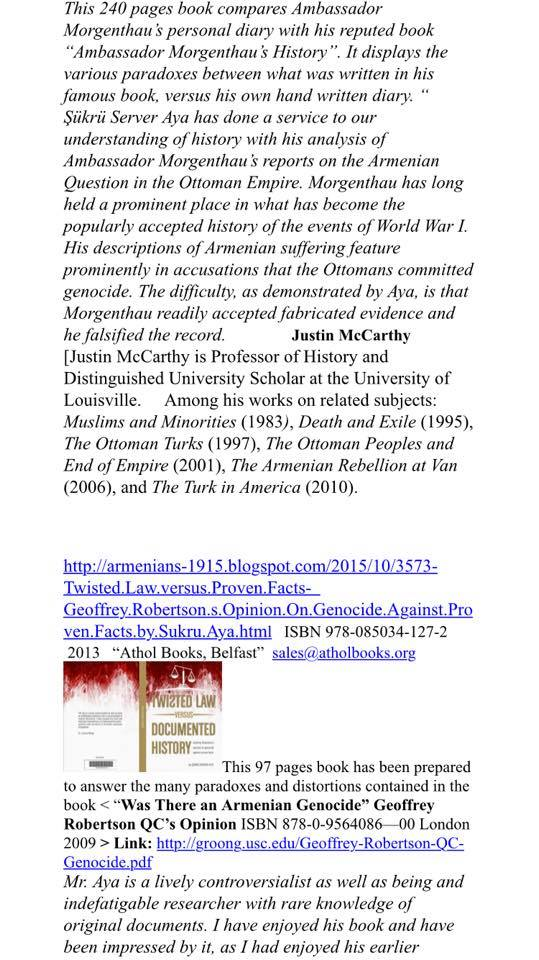

Two other books by Sukru Server Aya (Şükrü Server Aya) :
- The Genocide of Truth
- The Genocide of Truth Continues... But Facts Tell the Real Story


Genocide lie of the Armenians !


"The following article has been prepared based on the British and the United States archives. It proves categorically that the Armenian allegations were heard with great zeal by the British following the defeat of the Ottoman Empire, yet all the British efforts to incriminate the Ottoman government proved only the innocence of the Turks."
MALTA:


Hatırlamalıyız ki, işgal altında olduğumuz dönemde bile delil bulamadıkları için düşürülmüş "Malta Mahkemeleri" var. 
Tarih ise Temmuz 1921'dir. Sadece bu bile "soykırımcılara" verilebilecek yegane cevaptır.
Bilal N.Şimşir - Malta Sürgünleri:
Daha 1920'lerde Ermeni meselesinde Türklerin nasıl aklandığını belgeleriyle ortaya koyuyor....


28 Nisan 2015 Salı

Atrocities committed by the Armenians I


Ruslarla Ermeni Çetelerinin Bitlis ve Van'da Yaptıkları Soykırım


Van ve Bitlis vilayetlerinin işgali sırasında Ruslarla Ermeni çeteleri tarafından İslam ahaliye feci zulümler yapıldığı; Bitlis'e gelen Kazak süvarileriyle Ermenilerin kaçmakta olan İslam ahaliyi büyük-küçük, çoluk çocuk demeden katlettikleri ; Van'a Rusların yaklaştığını öğrenen Ermenilerin isyana teşebbüs ettikleri ve göç eden İslam ahaliyi takip ederek yollarda feciane bir şekilde katlettikleri, göç edemeyip içerde kalan binlerce kadın, kız ve erkeği vahşice kestikleri, Van'a bağlı Timar nahiyesi dahilindeki köylerden Zive, Mollakasım, Şeyhkara, Şeyhayne, Ayans, Paksi, Zorabad ve daha birçok köy ahalisinin göç edemediklerinden dolayı Ermeniler tarafından hiçbir ferd bırakılmaksızın tamamının soykırıma tabi tutulduğu, Rusların Hakkari'ye bağlı dir kasabasına geleceği sırada ortaya çıkan çetelerin yol üzerinde bulunan Kürd köyleri İslam ahalisinin erkeklerini katledip en büyüğü üç yaşında olan binden fazla çocuğu kılınç ve kamalarla parça parça ettikleri ve her parçalarını bir el kadar bırakarak çocuk cesetlerinden siper yaptıkları, üç dört yüzü aşkın Kürd kızının bikrini izale ederek kadınların ihtiyar olanlarını katl ve idam ettiklerine dair.


Massacre Committed in Bitlis and Van by the Russians and Armenians bandits.

During the occupation of Van and Bitlis terrible crueltis were commited by Russian and Armenian brigands against the muslim population ; cossack cavalry arriving in Bitlis, massacred muslim families and children fleeing the Armenians; hearing that the Russians were coming to Van, Armenians uprose and pursued the fleeing muslim population trying to escape tragically killed them, massacred thousands of women, young girls and men among those who didn't emigrate; all the population of the villages of Zive, Mollakasım, Şeyhkara, Şeyhayne, Ayans, Paksi, Zorabad and many other villages, who stayed unable to emigrate were all exterminated and not a single person escaped the carnage; on the eve of the arrival of the Russians to Dir, a town attached to Hakkari, Armeians made irruptions on the roads and massacred all the male Kurdish population of the villages situated on these roads and cut up into chunks with daggers and swords more than thousand small children the oldest less than three years and used the cut and broken bodies as trenschs, and ravished more than four hundred Kurdish girls, the old women being killed.

15 Ş.1334 (17.VI.1916)


Ermeni ve Rusların Van'ın Reşadiye Nahiyesine Bağlı Aşnak Köyünde Yaptıkları Mezalim

Van'ın Reşadiye nahiyesine bağlı Aşnak karyesine hücum eden Ermeni ve Rusların vahşiyane zulümler yaptıkları, kadınları ve çocukları diri diri yaktıkları, ihtiyar ve genç erkeklerin gözlerini oydukları, genç kızların alenen ve suret-i vahşiyanede namuslarına tecavüz ettikleri, Müslüman kadın ve kızlardan on beş tanesini ayırarak bir odaya hapsettikleri ve akşam eğlenirken bu kadınları çırılçıplak soyarak "Haydi namaz kılınız bakalım nasıl kılıyorsunuz" diyerek onlara cebrettikleri ve nihayet tecavüz ederek çeşitli işkenceler altında öldürdüklerine dair.


Attrocities committed by the Russians and Armenians in the village of Aşnak of the Township of Reşadiye in Van.

Russians and Armenians attacking the village of Aşnak in Van had committed savageries and atrocities upon its population, burning living women and children, tearing out the eyes of old and young men, openly violating young girls and choosing ten girl and woman and after shutting them up in a room adn at the night, while feasting and jeering stripped off their clothes and shouted : " Now perform your worship let's see how do you do it" forcing them to execute their will and then, while being raped and tortured they fell dead under rape and tortures.

16 Ş.1334 (18.VI.1916)


Ermenilerin Van Havalisinde Ruslarla Birlikte Yaptıkları Mezalim

Ermeni ve Rusların Van ve havalisinde Müslüman ahaliye büyük mezalimler yaptıkları, Van'ın Abbasağa mahallesinden Firdevs'in ifadesine göre işgalcilerin kadın, çocuk, genç, ihtiyar demeden İslam ahaliyi çeşitli zulümler yaparak öldürdükleri; hamile bir kadının karnını yararak çocuğu çıkarıp kafasını kestikleri; girdikleri evlerdeki insanları saatlerce işkence yaptıktan sonra öldürdükleri, on beş-on altı yaşlarında erkek bir çocuğu çırılçıplak soyarak cinsel organını kestikleri ve daha sonra doğradıkları; Amerikan müessesesine götürülen kadın ve kızların ırzına geçildiği, mezarlıkları kazarak defnedilmiş olanları dışarı çıkardıkları ve ziyaretgahları kazıp içlerine pislik doldurdukları hakkında.


Attrocities perpetrated by the Armenians and Russians in the neigborhoods of Van.

Armenians and Russians committed widespread atrocities in Van and its surroundings and accoridng to the testimony of Firdevs lining in Abbasağa quarter, the occupants murdered by torturing women, girls, aged muslims without distinction, ripping the helly of a pregnant women and extracting the young from the wombs to behead it, storming houses and killing the household after they had inflicted them tortures for hours; stripping off the clothes of a young boy aged fiftheen-sixtheen, and after cuting off his sexual parts they buchtered him, raping and violatind muslim women and those who took refuge in an american foundation, desecrating cemeties and exhuming buried corpses and profaning tombs of venerated persons by filling in filthes.

28 Ş.1334 (30.VI.1916)


Van ve Bitlis'in İşgali Esnasında Ermenilerin İslam Ahaliye Yaptıkları Soykırım

Van ve Bitlis'in işgali esnasında Ermeni çeteleri tarafından İslam ahaliye yapılan zulümler hakkında Mardin Mutasarrıflığı tarafından yapılan tahkikata göre mezalimden kurtulanların ifadelerinde; Ermeni ve Rus çetelerinin,  teslim olmuş olan köylerdeki ahaliyi katletdikleri, birçok ahaliyi ve çocuğu ekmek yapımında kullanılan ve tandır tabir olunan fırınlarda yaktıkları ve Vanlı komiteci Aremek'in çetesi tarafından yetmiş seksen hanelik bir köy ahalisi daha önce teslim oldukları halde tamamen katlediklerinin bildirildiği hakkında.


Massacre of Muslim Population During the Occupation of Van and Bitlis

According to investigations made by the governorship of the sanjak of Mardin, the evidence given by muslims who escaped Armenian atrocities; Armenians and Russians killed and hacked the population including children an women who surrendered, throwing men, women and children into earth oven for baking breads and burning them; the bandits of the kommitadji (armed Armenian brigands) Aremek killed the whole population of about eighty households of a village who had formerly surrendered.

29 Ş.1334 (1.VII.1916)


Ermeni ve Rusların Van, Bitlis ve Trabzon'da Müslümanlara Yaptıkları Mezalim

Rus işgali sırasında Ermeni ve Rusların Şiirt'in merkes kazasıyla Garzan, Sason, Kulp kazalarında Muş, Malazgirt, Bulanık, Hınıs, Pasinler, Eleşgird ovalarında, Tifnik, Karaköy, Talori dağlarında, Van,Bitlis, Genç, Dutak ve Maçka'da bütün kaza, köy ve mahallelerde Müslümanları yoketmek amacıyla yağma ve katliam giriştikleri; köyleri ateşe vererek insanları samanlığa doldurup canlı canlı yaktıkları; bazı çocuk ve erkeklerin kol ve bacaklarını kesip canlı ateşe attıkları, kız çocuklarına ve kadınlara tecavüz ettikleri, hastaları dipçiklerle öldürdükleri; insanların üzerinden atla geçip kılıçtan geçirdikleri, muhacirlerin üzerinde şarapnel patlattıkları, mal sahiplerinin mallarını ellerinden zorla alıp, vermeyenleri öldürünceye kadar dövdükleri ve hapse mahkum ettikleri, ayrıca bazı  yerlerdeki camileri kiliseye çevirdikleri hakkında katliamdan kurtulan ahalinin durumunun araştırılmasıyla görevlendirilen memurların tahkikatı.


Attrocities perpetrated by Armenians and Russians against Muslims in Bitlis and Trabzon

Durin Russian occupation, Armenians and Russians with the aim of exterminating the Muslims living in the chief town of the sub-prefectures of Siirt and the sub-prefectures of Barzan, Sason and Kulp; in the plains of Muş, Malazgirt, Bulanık, Hınıs, Pasinler, ELeşgird; in the mountains of Tifnik, Karaköy and Talori in the whole districts, villages and quarters of Van, Bitlis, Genç, Andak and Maçka, set about looting and massacring setting fire to villages, cramming people in to haystrores and burning them alive; cutting offf arms and legs of some children and men and then throwing them into the flames, violating girls and women, killing by knocking down with their rifles' butts ailed sick people, trampling on living persons with their horses and putting them to swords, throwing on immigrants people shrapnels and letting them explode, seizing goods and chattels from their properties and after beating to death those refusing to give up their goods, sending them to jail and according to investigations made by officials hearing those who had escaped, mosques were converted into churches.

5 N.1334 (6.VII.1916)


Atrocities committed by the Armenians I
ERMENiLER TARAFINDAN YAPILAN KATLiAM BELGELERi I
T.C.Başbakanlık Devlet Arşivleri Genel Müdürlüğü
Yayın no 49 , 2001


___________________
___________________


27 Nisan 2015 Pazartesi

Atrocities committed by the Armenians I


Massacres of Muslims and Jews by Armenians and Russian bandits


While Russians together with Armenian bandits were forced back from Hasankala to their own fronties, they killed a part of the two thousand muslim folk they took away and drove the remaining to an unknown destination in the inland;

in Erzurum the Russians and the said bandits executed nine people and sent the whole male population above forteen years to no one knows destination;

in the sub-distirict of Pekreç a self appointed Armenian tribunal sentenced some three-four hundred people to the gallows and hanged them;

in the surroundings of Aşkale, Tercan, Ilıca, Tavuskerd and Artvin no one muslim was left alive;

in Van Armenians after having killed about two hunderd woman and children, massacred eight to then thousand muslim people in the valley of Mahfuran;

the population of the village Hot on the boundary of Narman were entirely exterminated with machine-guns;

the majority of immigrants living in Marbi Sufla of the subdistrict of Çukur attached to Bitlis were put to the sword;

the entire villages of Cinis, Pezantan, Ergani and Şemerşeyh with all of their inhabitants were burnt up and due to the pretentious ignorance of the Kurdish Bedirhani Kamil many villages' inhabitants settled in the vicinity of Bitlis perished from starvation;
seriously ill children cared of in Bitlis Hospital were savagely slain;
in the village of Balıkan Corpses were thrown to the dogs to feed on;

Çukur women and girls were raped and old people burnt, small children were bayoneted and many other massacres committed;
all these facts are stated in copies of dispatches sent by the governorships of Erzurum, Bitlis and Mamuretülaziz.


Ermeni Çeteleri ile Rusların Müslümanlara ve Musevilere 
Yaptıkları Soykırım


Rusların Ermeni çeteleriyle birlikte Hasankala'dan hudud-ı asliyyeye sürüldüklerinde beraberlerinde götürdükleri iki bin islam ahalisinden bir kısmını öldürüp bir kısmını ülke içlerine sevkettikleri, 

Erzurum'da dokuz kişiyi idam edip on dört yaşına kadar olan erkek nüfusu meçhul yerlere gönderdikleri ; 

Pekreç nahiyesinde Ermenilerden oluşan bir mahkemenin üç-dört yüz kişiyi astığı, 

Aşkale, Tercan, Ilıca, Tavuskerd ve Artvin cihetlerinde İslam namına birşey bırakmadıkları, 

Van'da Ermenilerin iki yüz kadar kadın ve çocuğu öldürüp  Mahfuran Deresi'nde sekiz-on bin Müslüman katlettikleri, 

Narman hududuna Hot karyesi ahalisini mitralyözlerle tamamen imha edildiği, 

Bitlis'in Çukur nahiyesindeki Morh-i Süfla muhacirlerinin çoğunun kılıçtan geçirildiği, 

Ergani, Cinis, Pezentan ve Semreşeyh karyelerinin ahalisiyle birlikte yakıldığı ; 

Kürt Bedirhani Kamil'in şarlatanlığı sebebiyle Bitlis'e yakın bir yere yerleştirilen pek çok köy ahalisinin açlıktan öldüğü, 

ağır hasta çocukların Bitlis Hastanesi'nde vahşice öldürüldüğü, 

Balekan karyesinde katledilenlerin cesetlerinin köpeklere yedirildiği, 

Çukur'da esir edilen kadın ve kızlara tecavüz edilip ihtiyarların yakıldığı, 

çocukların süngüyle öldürülüğü vesair katliama dair 

Erzurum, Bitlis ve Mamuretülaziz vilayetlerinden gelen telgaraf suretleri.


21 B.1344 (24.V.1916)

Atrocities committed by the Armenians I
ERMENiLER TARAFINDAN YAPILAN KATLiAM BELGELERi I
T.C.Başbakanlık Devlet Arşivleri Genel Müdürlüğü
Yayın no 49 , 2001


______________________________
______________________________


ilgili:


18 Ocak 2015 Pazar

Armenia Secrets of a "Christian" Terrorist State


Many Americans are asking the question, “Why do Muslims hate the United States?” 

Unfortunately, the Muslim world has good cause to not like Americans and this book documents one very good reason this is true. This book could well be titled One Good Reason Why Muslims Hate Americans.

Of course, not all Muslims hate the United States. I was in Istanbul, Turkey, on September 11 producing a video titled The Seven Churches of Revelation and doing research on this book. (Many Americans do not know that Asia Minor of the Bible is today's Turkey. Many Christians are not aware that Turkey is the second most important country in the world to historical Christianity.)
This modern-day Near East democratic country was founded in 1923 because of the genius of one man: Mustafa Kemal Ataturk (1881-1938). He instituted extensive reforms and was truly one of the great world statesmen of the twentieth century. He threw the sultans out of the country and removed the Muslim religious leaders from their powerful positions in government. Women were given the right to vote and work in any profession.

Ataturk believed Turkey must turn to the West if the nation was to grow and prosper. Turkey continues today in the Ataturk tradition. It is the reason this Muslim nation is such a close friend and strong ally of the United States, more so than any other Muslim nation.

Within thirty minutes of the third plane hitting its target in Washington, D.C., the prime minister of Turkey was on national television telling citizens he had placed the military on the highest alert. He also said he had called the president of 5 the United States to say if America went to war, his country was ready to go to war also because Turkey and the United States are friends, allies, and partners.

I wish every American could have been with me to experience the reaction of the Turks to the cowardly attack on the United States on September 11, 2001. Taxi drivers, waiters, waitresses, employees in the small shops and large stores, government employees – all, without exception, voiced genuine sorrow and support for their government's willingness to send their young men to fight the war on terrorism with the United States.

I have uncovered facts that prove Armenian-Americans are spreading tall tales claiming a massacre and genocide in an effort to get mega-dollars out of both the Turks and American Christians to benefit their 150-year-old “ancient” homeland. The question for my fellow Americans to answer is simply this: Whom do you believe – other Americans who saw the Armenians, very much alive, leaving the Ottoman Empire? Or Armenians who merely claim 1.5 million of their people were murdered by the Ottoman government?

This book is based on historical evidence, much of it from Armenian sources. American Christians are invited to search the total record for themselves to determine who is telling truth and who is making up and spreading tall tales for their own selfish reasons.

In 1992, Armenia captured 20 percent of the lands of Muslim Azerbaijan through a surprise, unprovoked attack. The Armenians thrust more than a million Muslims from their homes without compensation, forcing them now to live in squalor in tent city refugee camps. The Russians gave Armenia more than a billion dollars worth of military arms and supplies. According to a U.S. Congressional Study Report, over the past ten years, the United States has given Armenia 1.4 billion dollars in foreign aid while discriminating against Muslim Azerbaijan by cutting foreign aid to it. This is one reason many Muslims hate Americans.

Perhaps Congress passed such a law because the Armenians claim to be the first Christian nation on earth and Azerbaijan is a Muslim country. Is it any wonder gasoline prices have steadily increased during this same period of time because the Middle Eastern countries we obtain oil from are also Muslim?

Now, after September 11, President George W. Bush is attempting to reach out and secure support of Muslim nations – including Azerbaijan – to help in the U.S. war on terrorism.

One reason this small state is important to America's war effort is because of how near it is geographically to Afghanistan. The president has asked Congress to repeal the 1992 law cutting off foreign aid to Azerbaijan. As a result of this, Armenian-Americans launched a nationwide campaign to oppose President Bush's effort to get the support of this important Muslim country. Armenian-Americans claim it might harm Armenia. Apparently, this is more important than the national interests of the United States. 

At the same time Armenian-Americans are fighting President Bush, they are also working to get an Armenian terrorist out of a California prison. This Armenian terrorist assassinated a Turkish diplomat in 1982. The terrorist was caught, tried, found guilty by a California jury, and sentenced to life in prison without parole. Armenian-Americans want this convicted assassin back on the streets of the United States. It is especially important after what occurred on September 11 that we, as a nation, establish as many close friendships within the Muslim world as we can. It does not make sense to continue to support a terrorist state, like Armenia, even if it claims to be Christian.

It isn't right for Congress to react to the political pressure of a small but loud group calling themselves Armenians. It is long past time to examine the Armenian record. This tiny state's chief export since 1918 has been terrorism and the chief import has been foreign aid from Christians around the world. Armenians to establish what they claim is an independent and free state. This book will also examine the merits of the Armenian claim they are Christian. Are they really? 


The facts that will be proved in this book are as follows: 

In 1890, a tiny gang of Armenians began a terrorist revolutionary movement within the Ottoman Empire to obtain the lands and property of Muslims free of charge by conquest.

Until 1914 and 1915, this band of troublemakers within the Ottoman Empire was so small the Ottomans ignored them. Then Russia invaded the Ottoman Empire and these Armenians flocked to join them, believing the Russian czar would give them the Ottoman lands they coveted and schemed to obtain.

Turkish Armenians pretended to be friendly neighbors of the Ottomans by day but began destructive terrorist attacks behind Ottoman military lines by night. These terrorist attacks on Ottoman soil hurt the Ottoman troops, hindering their ability to fight the Russians. The Ottoman government was forced to remove all Armenians from behind the battle zones because they could not determine which Armenians were terrorists and which were not.

The sad story is what the Armenians did thereafter to deceive Christians of America and the world. The Armenian leaders sent paid agents throughout the Christian world to tell untrue stories about how hundreds of thousands of their Christians had been massacred by the terrible Turk Muslims.

Christians throughout the world must stop taking the word of Armenians at face value and examine the truth for themselves. This Christian, in making an independent examination, has discovered the truth cannot be found on Armenian web sites or in books and articles written by Armenians. Most Muslims, have been forced out of the country. Now Armenia is one of the most closed Christian societies on earth. It has just one “official” church, which is a part of the state and given authority by the Armenian constitution. There is no such thing as the separation of church and state in this tiny land. 

Contrast this fact with the Turks, whom the Armenians love to hate. It is interesting to note that there are more Armenian Churches in Turkey than there are in Armenia and contrary to most other data, they make available on the web, that one is absolutely correct. I have recently been to Turkey. I witnessed with my own eyes that Turks and Armenians live and worship together in great freedom, harmony, and friendship. This is quite a contrast with the ArmenianAmericans' ugly misrepresentations and evil efforts to plant the seeds of hatred and rage, here in the United States, against Turks. Just what kind of Christianity do these ArmenianAmericans
practice?

The long list of deception, fraud, abuses, massacres, and terrorist acts Armenians have committed are documented in this book. These are Armenian secrets they don't want the Christians of the world to know about, but they are revealed and documented in Armenian sources. These reports are factual reports by Armenians themselves.

Every Christian and every public official should read this book before agreeing to either give money or vote for meaningless resolutions attacking modern-day Turkey, solely based on the Armenian tall tales that were invented by them, in order to get lots of free stuff from the Christian world.

There was no “genocide” as they claim. Direct evidence will be provided, several times, from Armenian sources that the Armenia's government directed terrorist attacks as official state policy. There have been Armenian terrorist attacks and murders within nations all over the world in recent years.

I am not Azerbaijani, Georgian, Turk; I am not Armenian. I am a Scottish-American, whose first Scottish ancestor came to America in 1686. I am a Southerner, a lifelong Baptist, and an American taxpayer. I have written this book under the light of extensive research in locations such as Washington, D.C., Rome, Paris, London, Moscow, and Istanbul. It would have been helpful to research in Armenia but their archives are not open to the public. 

The archives in Istanbul, Turkey, are very much open, however, and have been for some time. The irony is that the files in Armenia's capital of Erevan and Armenian Revolutionary Federation offices in Boston are still closed to researchers and the public. What are they hiding? Why does Armenia have an Armenian Revolutionary Federation office in the United States?

…Hubert Hoover directed the U.S. effort to help rebuild Europe after World War I. He experienced only one failure and that was the dictator-run state of Armenia. This future American president stated that Armenian corruption “would be the greatest scandal in American charitable history”. The Armenians responded by attacking his character. 

Readers of this book will discover from the words of today's Armenians that this attitude of ingratitude continues. The proof will be that the Armenian attitude is that American citizens owe their tax dollars to Armenia.

There are several U.S. citizens, who have researched Armenia and published their findings. Each of them has been subjected to Armenian campaigns of terror. Consider but a few such individuals:

• Professor Stanford Shaw of UCLA. Armenians bombed his home and terrorized him in several different ways.

• Professor Heath Lowry of Princeton University was recently forced out as chairman of a Near Eastern studies program because of a two-year hate and smear campaign directed against him.

• Professor Justin McCarthy of the University of Louisville has been subjected to all manner of character attacks and attempts to have him removed from his teaching position.

• Film maker Robin Williams recently produced a documentary film titled The Biblical Treasures of Turkey. Several times when he attempted to show his film, young Armenians disrupted the showings. On one occasion, Armenian youth invaded the theater by throwing stink bombs and forcing the evacuation of the audience.

Once the announcement was made that this book was to be published I experienced a vicious attack directed by the Armenian Assembly of America. Consider the following examples of threats upon my life. I take such threats seriously because in recent years Armenians have murdered some seventy people around the world, four here in the United States. 

• “I just wanted to tell you that you will burn in hell for putting down the first Christian nation. I will make sure to show up to your funeral, hopefully soon, and piss on your pathetic corpse.” 

• “U deserve to die a beast. Some Armenian is gonna kill u some day. And ur not gonna like the Armenian wrath!!!!!!!!!!!!!!!!”

• “Armenians are taught hate from birth and I know it is extremely wrong that it has been aimed at the Turkish. I myself do have very close Turkish friends and I love them with all my heart. I don't think it is right to say hateful and bad things against all Armenians. I have nothing against Turks and I think the Turks have made wonderful contributions to the world through their culture. I am a Christian, although I am not traditional Armenian Orthodox.”

I ask every reader of this book to examine the words I have written with an open mind. I ask every reader to check out the facts I have presented for themselves to determine if the material I have presented is true. The reader will note that I use more Armenian sources and proof than from all other sources combined. Once the reader determines truth it will be for that individual to determine what additional action he or she should do to right a great wrong done to the Muslim world in the name of Jesus Christ. 


– Samuel A. Weems,
member of Calvary Baptist Church,
 Hazen, Arkansas, April 2, 2002

____________________________


Introduction
Holy Terror
The Beginnings
Armenia Founded as a Dictatorship
Armenia Loses Unprovoked War on Georgia
American Admiral Sees Armenian's Claims as “Absolutely False”
What Kind of Christians Are the Armenians Who Claim To Be the First Christian State?
Armenian Cruelty
Paid Armenian Agents Mold Public Opinion in the United States 
Armenians Join Hitler's Nazi Cause 
Armenia in Today's World Still a Terrorist State


INTRODUCTION

Where did the Armenians come from? One doesn't have to look back very far into history to find the answer. 

The beginnings of what can be called modern-day Armenia is filled with blood –Muslim blood. In 1820, czarist Russia began the first of several attempts to expand its empire westward in an attempt to obtain an age-old dream of warmwater ports. The czars began a conquest to obtain Ottoman Empire lands all the way to the Mediterranean and open seas.

The Russians were not able to secure a warm-water port, but they did move their boundaries westward. In the years that followed 1820, the Russians promised the Armenians they would help them establish their own state. At that time, the Ottoman Empire was in a final period of decline and decay. The Russians promised to create a “Greater Armenia” in eastern Anatolia. The Russian promise was substantially more lands between the Black Sea and the Mediterranean than the Armenian people had ever occupied at anytime in their history. In fact, there had never been a truly independent Armenia. There had never been a true “Greater Armenia”.

The English fanned the flame by calling the Asia Minor of the Bible Armenia. It was Prime Minister William E. Gladstone, in the early 1880s, who concocted the idea that it was in the British's best interests to break up the Ottoman Empire. He wanted to create a number of small friendly states under England's influence in place of the large Ottoman Empire. One such small state would be called Armenia. Gladstone asked the British press to refer to eastern Anatolia as “Armenia”.

In 1877 and 1878 there was another war between the Ottoman Empire and Russia. As the war neared its end, the Christian Armenian patriarch of Istanbul, Nerses Varjabedyan, asked the Russian czar to retain the lands his troops occupied in east Anatolia. Once the war ended, the patriarch asked Grand Duke Nicholas to annex all eastern Anatolia into Russia and to help establish an autonomous Armenian state, much like what was being established for Bulgaria. Of course, this didn't happen as it was not in the Russians best interest.

The British feared such Russian influence with the Armenians. They concluded that Russia would be a greater threat than the Ottomans. They realized a Russian-dominated “Greater Armenia” would open up the Persian Gulf and the Indian Ocean where the British possessions in India could be threatened.

Greater Armenia did not come into being as the Armenians wanted. However, the Armenian officers in the Russian army continued working to stir discontent among the Ottoman Armenians by suggesting they work by themselves to secure the same sort of independence as that secured by the Christians in the Balkans. 

It must be noted that in the 1800s, Armenians were scattered within and beyond a region that today marks Armenia, Georgia, Azerbaijan, Iran, and eastern Turkey. Everywhere, except in a few small pockets, Armenians were a small minority population. As the Russians acquired lands south of the Caucasus Mountains, they removed the Muslim populations that came under their control. The Muslims were replaced with Christians whom the Russians thought would be loyal to the Russian Christian government. Christian Armenians were the focal point of this policy and were given lands the Russians obtained without paying any compensation.

In the Erivan Province, which is the heart of modern-day Armenia, the majority of the population was Muslim before they were removed. The Russians replaced them with Armenians. This is how Armenia acquired what it today calls its “historic homeland”, not as direct descendants from the biblical Noah, as many Armenians claim, but by Russians between the years 1827 and 1878.

During the Russian-forced Muslim removal, it was not uncommon for up to one-third of the Muslims who were forced off their property to die. The Russians forcibly removed some 1.3 million Muslims between 1827 and 1878. Russia started wars with the Ottomans in 1828, 1854, and 1877. Each time the Russians would advance, then be forced to retreat. When the Russians retreated, the Armenians, fearing Muslim retaliation for the violence they had done to the non-Christians, would flee with the Russians. 

In the 1890s, there were Armenian rebellions in eastern Anatolia. The end result was many Muslims and Christians were killed. The same thing happened again during the Russian Revolution in 1905 in Azerbaijan. A civil war broke out again between Christians and Muslims when World War I began. 

Armenian revolutionaries, many trained in Russia, attempted to take major Ottoman cities in eastern Anatolia. They did manage to capture the unarmed city of Van and hold it until the Russians arrived. The Armenians killed all but a few Muslim civilians in the city and nearby villages. Such killings by both sides went on until 1920, two years after the war officially ended. Many of the Muslim Ottoman Turks and Armenian Christians died from starvation and disease.

There is no historical mention in textbooks of this colossal Muslim loss. These textbooks tell the stories of massacres by Muslims of Christian Armenians, Christian Bulgarians, and Christian Greeks. But there are no written accounts in Western textbooks of Muslim losses and massacres committed by Christian peoples.

In the United States, the Christian Armenian-American people have mounted campaigns in recent years to get cities, states, and the national government to condemn Muslim Turkey for committing what the Armenian claim is a genocide in 1915 of some 1.5 million of Christian Armenians. If such a story is made up by Armenian-American Christians to support Armenian agendas, other Christians must oppose them.


more to read:
Armenia Secrets of a "Christian" Terrorist State
Weems Samuel A.
St.John Press e-book (with "oxumaq" you can open pdf)


Do you want to know what happened, or have you already decided to take part in running this political game?


How would you feel about having to send your children to any  school  if lies are taught about your 
people's heritage?.....

___________________________________


"Genocide Denier Attacks Shark in Australia"

Thank you!

I would like to acknowledge the Gadigal people of the Eora nation, who are the traditional custodians of this land on which we are gathered. I would also like to pay my respect to the elders past and present of the Eora nation and extend that respect to other Aboriginal people present.

I would also like to acknowledge, the presence of the Members of Parliament here with us, and other distinguished guests. 

I would also like to thank the New South Wales Parliament and the Parliamentary Friends of Turkey for inviting me to speak in this parliament.

Was It a Genocide?

Well, was it a genocide? Why is this even asked? Why do people want to characterize an event without having to study what happened… a century ago? And – how about this for a preliminary question – what is genocide? 

Genocide is a characterization of an event. Genocide is not the event itself. It is an epithet, not a name of an event. It is a legal characterization given to an event if the event falls within the meaning of the term as defined in the Convention adopted by the United Nations General Assembly on December 9, 1948. 

According to Article 2, genocide means an act committed with “intent to destroy,” and the group that is being destroyed is either national, ethnical, racial or religious, and is destroyed as such. That’s what it says. Notice the “as such.” Notice that “political” is not mentioned as a group identifier. The victims of a response to a rebellion are not victims of genocide, no matter what. If you do not want your wife, your husband, your child or your next door neighbour to be burdened by your own act of rebelliousness, then the time to think of it is before committing an act of rebelliousness against the state. The intent on the part of the state in cases of a reaction to rebellion is to maintain sovereignty, not to destroy a group of people. Remove the political condition of rebellion, and you shall also remove whatever state aggression happens as a result. No rebellion, no deportations, no massacres. The rebelling group, though it may have a national, ethnical, racial, or religious identity, is a political group once its purpose is to replace the sovereign, once its intent is to destroy the state in its current existence. In the Armenian case in World War One, the Armenian leadership was leading a rebellion under the intention – shared by its sponsors, the Entente – to destroy the Ottoman state. The Ottoman state, was not trying to destroy the Armenian people – and it is a fact that many Armenians in Anatolia were left unharmed – rather, the Ottoman state was trying to save itself, and to survive as a sovereign. 

Considering the weight of the legal characterization that is genocide, a responsible person would not use genocide as a name, unless it was legally determined to be genocide, and Article 6 of the Convention states that persons charged with genocide “shall be tried by a competent tribunal of the State in the territory of which the act was committed, or by such international penal tribunal as may have jurisdiction with respect to those Contracting Parties which shall have accepted its jurisdiction.” These are exact words, and they mean that only suitable courts may charge a person with genocide. Neither of the types of tribunals stated in the article have ever declared that what happened to the Armenians in 1915-16 was genocide, that’s one point. Another point is that persons are to be charged with genocide, not a nation. The third point is that if you look at the wording you see that there was a clear forward-view to the term genocide. Meaning, it was designed to prevent future – future – genocides, and that’s the “shall” part. “Shall” has a clear tense-distinction. Future. That was the idea that was put to paper. Genocide was something to be prevented from happening in the future. It was not designed to become a source for a disingenuous discourse that consists of false accusations about the past. 

Whose Fan Are YOU?

Now that we have a decent grasp of what genocide is by definition, let us consider the difficulty of characterizing an event in general. It could be any event. There is a difference between facts that make an event and the characterization of the event. We might be looking at the same thing and characterize it differently. It happens in sports regularly. In soccer. I am from Israel, and in Israel to this day, the thought of Australia brings to mind one name: Charlie Yankos. People know him here? Charlie Yankos? Well that name still keeps many Israelis up at night. You’d think there’d be other names to keep Israelis up at night, but no. It’s Charlie Yankos. Israel and Australia used to tangle in the 1980s in the World Cup qualifiers. So, in soccer – it’s a game, it’s a sport, right – say there is a semblance of contact in the penalty box, a possibility of a foul, i.e., an event: do you think both sets of fans are going to characterize the event in the same way? No! They’ll see the same thing, but characterize it differently. 

But that is what historiography does, it characterizes events according to the needs of collective memory, to strengthen group solidarity. The characterization of the event informs us on whose fan you are, than it does on what happened. So whose fan are YOU? Are you a fan in this political game in which only Armenians and Turks are on the field? Who runs this game? Do you want to be the referee? As the referee you’d have the players of both teams begging that you characterize events in a certain way. You don’t see players asking the referee “hey, why are we even playing this game?” They are so caught up in the game. Being the referee in that particular situation is a position of power, as the players of the two teams hold their breaths, waiting for the referee to decide how to characterize what happened. Referees would like to freeze this moment of getting attention, before actually making a decision that will disappoint one of the two sides. Such is the issue between the Armenians and the Turks. 

For some reason – which is not that big of a mystery if you come to think of it – the referee, or referees are suspending the decision. It might be clear that there was contact but no foul, but the important aspect of this event and its characterization has become this frozen moment in which Turks are shown as having to plead with the referee that there was no foul. It is a humiliating position to be in, if you are the Turks. It is frustrating for the Armenians, who for a long time think that they are about to get a penalty-kick. They’re not going to get it. And let me tell you something important: there are no real referees in the international political system. But a great power, or an aspiring power, would like to be thought of as a referee. Referees are the most powerful when there is a situation in the penalty box. Imagine a referee that was able to delay the decision, and just bask in the moment. Isn’t that a referee’s fantasy, the best of both worlds: to have both teams beg for a favorable decision, and yet not have to make a decision on the characterization of the event. 

In the game between Armenia and Turkey there are no real referees, there are people who pretend to be referees, but they are actually extensions of whoever is running the game – and they want to freeze this moment, to keep this question of foul contact in the penalty box as long as possible – the most dramatic state of the game on pause – so that the Turkish team will constantly appear as running to the referee in “denial” of having committed a foul. This image of denying that something happened is the whole point, and it has a life of its own, regardless of whether there was a foul in the penalty box. The Turks are constantly shown as saying “no” to something, like the players who run at the referee to say, “no, no penalty.” A century after the contact in the box. The Turks are constantly shown as if they are denying that something happened. 

Denying a Fact or Refuting a Characterization?

Let’s talk about real denial. Holocaust denial – denial – is something completely different. To say, for instance, that there were no gas chambers in Auschwitz is to deny a fact. To say that Jews were not executed by gas chambers, is to say that an event did not happen. In our soccer analogy, to say that the players weren’t even in the box would be a denial of fact, while to say that the contact in the box does not qualify as a foul is to refute a characterization of an event. One denies facts. 

If something is not a fact, then it is not denied, it’s refuted or rejected. People might call you a denier to make it seem as if they have ownership of facts. It is a tactic. It is my understanding that the Turkish government recognizes the contact in the penalty box; it recognizes every aspect of the Armenian suffering in 1915-16, but it rejects the biased characterization of the event. The fact that those who accuse Turkey of genocide and denial are ignoring Turkey’s clear position, and ignore the distinction made between fact and its characterization, should serve as a strong indication that there is a political commitment at play to press this issue against the Turks regardless of facts. A genuine study is that of facts. To study the actual contact first, before deciding how to characterize the events. 

Those who study the facts full-time, are the very opposite of deniers of facts. Justin McCarthy was here in Australia and he was accused of terrible things. This Dr. McCarthy, whom I have had the pleasure to meet once at a conference in Sarajevo, is not a denier of facts. He is dedicated, as a scholar, to knowing more about what happened. This impressive man, a walking encyclopedia of a man, has spent a lifetime of studying the facts of the events and surrounding the events. I sit and study facts all day. This is what I do. I am not a big-time barrister in London, I am not even a recording artist. This is not a gig for me. I am committed to studying facts. I am finding them. Give me time, and these facts will become known. Give me a platform, and these facts will become known. Would you publish my work here? Do you want to know what happened, or have you already decided to take part in running this political game? 

The Letter by FM Julie Bishop

Even a well-articulated letter such as that drafted by the Honourable Julie Bishop in June – stating that the tragic events are not characterized by the Australian government as genocide – even such a letter only extends the game if it is accompanied by efforts of other branches of the Australian government to utilize the media and education to indirectly promote the belief that the event should be characterized as genocide. It is clear to me that by making the public believe that it was genocide, great pressure is placed on the Turkish government, and then the Western governments reap the benefits of this pressure, and letters such as the one by the Australian Minister of Foreign Affairs are considered a favor to Turkey, to which a price is attached. It is like a coupon that Turkey is expected to accept. However, the jig is up on this type of double play. 

Political Power

Why is it so easy for scholars who are not Ottomanists to publish work that is readily accessible to a wide audience in the US, in the UK, and here in Australia? Why is it so easy to publish a book in which truly skilled scholars such as Dr. McCarthy are disrespected? Why is it so easy to call Turks genocidal? To accuse an entire nation of something so abominable without the expertise, without the knowledge of Ottoman history and language? 

Samantha Power, now representing the United States as its ambassador to New York, she did this. There was power behind this book of hers. Infrastructure. Typically, books that are filled with inaccuracies – the work of shoddy research – are not expected to win prizes. This book won the Pulitzer Prize. No joke. It presented “Turks” as perpetrators of a terrible crime in a matter-of-fact way, used imprecise descriptions, citing fiction as fact, advocating a distinctly anti-Turkish view of history. 

Samantha Power is a political actor. Look at what she said about Russia in the book and what she has to say about Russia now. Her opinion changes according to the political needs of the United States government. Period. So yeah, she did it, she freely tarnished the image of an entire nation without being able to cite Ottoman sources, by simply and unabashedly relying on English writings of Anglo-American political actors. Also, Michael Ignatieff, a famous friend of hers, almost the Canadian prime-minister, did it. Michael Oren, another famous friend of hers, the former American-turned-Israeli ambassador to the United States, he did it. 

These people are not Ottomanists, and, judging by who they cite, they did not spend any time studying first hand facts on Ottoman history and language. They are famous Harvard scholars and political actors, who have access to readers, and influence public opinion. They do not seem to want to access facts. They have access to readers, to the public. Power. And they use this power to make terrible accusations against Turks in general, that they are genocidal and deniers. Have these scholars no shame? Do we know why people who do not know what happened – and do not want to know what happened – are pretending to know what happened and are clearly popularizing a phrase that combines “Armenian” with “genocide” as if a name? It makes you want to ask “What’s going on?” 

Political Purpose

Here’s what’s going on. The accusation of genocide serves political purpose. Three main purposes, one that is great-power specific, one that is Turkish-specific, and one that is Armenian-specific. 

The first one, it allows great powers, usually the United States, to replace disfavored regimes in an indirect manner. Instead of just using sheer force to dominate a region, which also happens, it is more advantageous for a great power to do so by setting up a revolt that would lead to a reaction by the sovereign, that would lead to international acceptance of an intervention led by the very same great power that concocted this mess. This way, the sovereign gets the blame for killing its own people, and the great power, typically America, typically if you have oil or other important resources, gets to show up and save the day, as Samantha Power would have it do. Interestingly, the definition of genocide as it was drawn up does not consider political groups to be victims of genocide. 

Meaning, if a great power wants to stage a genocide in order to topple a regime, then it will have to make it seem as if the group of people is persecuted for religious or ethnic reasons. Other times, the great power just doesn’t care. This happens when the popular perception is all that the great power cares to affect, without having to admit that it is misusing the term in the legal sense. For instance, in oil-filled Libya, those were clearly political rebels who were facing annihilation by [Muammar] Gaddafi, and yet that did not stop President Barack Obama from using the phrase genocide in justifying the planned intervention. 

By the way, at the time, Power was a member of Obama’s National Security Council. Another point of interest regarding how great powers use the genocide concept is that the Genocide Convention gives no heed to the fact that many massacres are the result of the intent to instigate by a third party to the conflict. It has been common to point a finger at third parties who did not stop massacres, suggesting that they were complicit. However, there is not much discussion in academia on how the Genocide Convention sets free third-party instigators for whom it serves a political interest to encourage a rebellion, even when the terrible consequences are anticipated. 

In this instance, the great power mobilizes a group within a state to rebel and attempt to replace the sovereign; then, either the rebellion succeeds and the great power achieves a moment of success in its foreign policy, or the rebellion fails and then the sovereign state that quelled the rebellion is blamed for the atrocities of war. This is not genocide, this is sophisticated imperialism.

The second purpose, the Turkish-specific aspect of the accusation is that it provides the United States and the West with a political tool, a “stick” to raise against Turkey, to press it to make policy decisions according to their wishes, to deny Turkey its place in the European Union, to weaken its image and influence. The lack of a perfect cultural affinity between the US and Turkey has meant that there is no such brotherhood as that which exists among the English speaking countries. Applying for a visa to come here, it was interesting to learn that the information collected as part of my application is to be shared with government agencies in the US, the UK and Canada, the English-speaking gang. Turkey was not one of them. There is no complete trust in Turkey. Turkey’s different. 

However, if you are the United States, you are thinking that there has to be a way to make sure Turkey always picks up the phone when America calls. Sure, there have been carrots in this relationship. Turkey has done very well since the 1950s thanks to cooperation with the United States. But it’s doing much better now, some might say that things have been going too well for Turkey. Its government has reached a level of stability to the point where measures have finally been taken to reduce the influence of outside entities in Turkey. This is a problem for those who thrive on having outside influence around the world. It means that the Turkish government is vilified on Western TV whenever it has to take bold steps to maintain its democracy through fighting outside interference. It is not necessarily that there are better and lesser democracies, but rather sometimes some democracies face more challenges than others. As Turkey is strong enough to face new challenges it has not faced before, this also means that from the West’s perspective there is a need for means to influence Turkey’s decisions. Hence, the Armenian issue. 

Three, the Armenian-specific purpose of the genocide accusation is that it distracts from a real ongoing grievance, and that is the Armenian occupation of Nagorno-Karabakh. As long as the headlines on the Armenians in the West show them as victims, there is not enough oxygen in the public’s brain to think of them as aggressive occupiers. The Armenian-Azeri conflict is an explosive conflict that has ignited the popularization of the genocide accusation as a proxy-polemic, almost like a replacement-conflict. As long as Nagorno-Karabakh is occupied, Armenian memory will be politicized, and the Armenian people will continue to suffer from this ill-advised politicization of Armenian memory. Instead of better understanding their own past, instead of enjoying greater international relations in their present, the Armenians are locked out of acting toward a more prosperous future for Armenia. It is a simple formula: settle the issue of Nagorno-Karabakh, and the proxy-polemic would fade away, the misuse of genocide will stop. Granted, the genocide accusation began before the occupation of Nagorno-Karabakh, but the two other purposes have already began to lose their momentum. 


In total, around 25,000 people were killed and more than a million people – most of them Azeris -
lost their homes and 14 percent of Azerbaijan’s population currently lives as refugees.


Studying “The Study of Genocide”

There is so much material to be studied – on the British political actors in the late nineteenth century, on the Anglo-American imperialist cooperation leading up to the twentieth century, and on the emergence of genocide as a field of study in the last two-three decades – that over time this information will be revealed and undoubtedly expose the political designs of this genocide accusation against Turkey. There is so much interesting material that there ought to be an association of scholars that are studying the study of genocide, studying the people behind the organization of genocide study: how did this field of genocide study, this genocide study, come into being and why. Study all of these people who made ungrounded accusations against Turkey, name by name, one by one. It is an utter disgrace to accuse an entire people of genocide without caring to study the facts. Why has it been so easy to issue such accusations against the Turkish people? What aspects of prejudice are related to this? Racism? Islamophobia? Racism and Islamophobia not necessarily as the reasons why this accusation is made – the reasons for that are political, as I stated – but racism and Islamophobia may explain why it is so easy in the West to make the accusation and have it be so effective in convincing the public of Turkish wrong-doing. 

“Credible Independent Experts”

To me, it is an academic priority to understand what such people have done in the name of academia. How political interest has disguised itself as academia. It is already a fact that Cass Sunstein, who happens to be Samantha Power’s husband, and a friend of the US president, pushed for the US government to use scholars for its own interests. On the same year of being appointed the Administrator of the Office of Information and Regulatory Affairs – a lofty US government position of information control – he co-authored an article in support of government involvement in academic affairs if it helps the government: “The government can partially circumvent these problems [referring to accusations of conspiracy against the US government] if it enlists credible independent experts… There is a tradeoff between credibility and control, however. The price of credibility is that the government cannot be seen to control the independent experts.” This is in the Journal of Political Philosophy, volume 17, issue number 2, 2009, page 223. 

This begs an immediate question that should be asked more and more: How much of this genocide accusation is done by the US government? How much of this academic discussion is really a manifestation of political power? It is important to remember that the term genocide became international law because of power, not morality. Morality is owned by power. The US itself was the driving force behind the convention but it did not sign the ratification of the Genocide Convention until the 1980s. Why? Because it feared that there would be accusations made against what happened to the Native Americans and the African slaves. 

The American enterprise that is known as the International Association of Genocide Scholars took care of that problem. Out of 20 issues of Genocide Studies International by the IAGS, upon its thousands of pages, only 9 pages of one pathetic article discuss the Native Americans. The verdict, surprise surprise, is that it was not a genocide per se. And that was that. When you have power, you control the conversation, and then you control the content, you control the language, you control what people think, and then you can talk about freedom. Freedom is not a problem for the government that has enough power to control thought. Do you know who thought the Native Americans suffered a genocide plain and simple? Raphael Lemkin. 

Rafael Lemkin

Let’s talk a bit about Raphael Lemkin. When the term genocide first became published in a 1944 book, Axis Rule in Occupied Europe, under Lemkin’s name, he was employed by the United States government.

The book has the marking of having more than one author, and it is questionable, in my view, that Lemkin even wrote it, considering the quality of the English and the fact that he had only made it to the US in 1941 for the first time. There was no American TV to influence foreigners’ English at the time. There was no Bonanza or MacGyver on Eastern European TV in the 1930s. He could not have written that book on his own, and yet he does not credit anyone for either translating it or editing it, not even proofreading it. It’s odd. It is even odder considering that in the late 1950s when he was no longer employed by the US government, his autobiography was dismissed by publishers in the US partly because of his poor grammar. This was a problem 15 plus years after he immigrated, but it was not a problem just two-three years after he immigrated to the US? That is really odd. The only way for this to make sense is if he didn’t really write the 1944 book, and, guess what, he was working for the US government at the time, when a whole bunch of ivy-league graduates could do it for him. 

Regardless of who actually wrote the book, it coins genocide without regard to the Armenians. It does not mention Armenians, not even once. And yet, Yair Auron, an Israeli scholar who is affiliated with the Zoryan Institute – that’s an institute that promotes Armenian affairs in academia – is quoted all over the internet as saying “When Raphael Lemkin coined the word genocide in 1944 he cited the annihilation of Armenians as a seminal example of genocide.” That is not even a half-truth, but an entirely false statement. Why is this scholar saying such a thing if it is not true? 

Auron only began to write profusely about the Armenian issue in the 1990s, 15 years after completing a doctoral dissertation on a completely different topic, on Jewish youths in France… he might as well be a barrister. And he still goes on TV shows in Israel, writes for Haaretz from time to time, unopposed, without anybody questioning the veracity of his statements. Notice that I am not calling him names, like is done by such people who call Dr. McCarthy a denier; notice that I am not degrading Auron just because he doesn’t agree with my opinion. I am pointing out an actual statement made by him that is completely false.

This Dr. Auron has been active in facilitating the teaching of the Armenian case as genocide in Israel, holding a position of influence in the main college in Israel that educates the teachers of tomorrow. There are organizations that frame people’s understanding of history in anti-Turkish ways. An “international educational” organization such as Facing History and Ourselves is said to reach over 1.5 million school kids, through close to 20,000 educators in the US and Switzerland. 
No wonder, then, that in Switzerland they believe these stories about World War One and Lemkin. A false narrative has made it seem as if Lemkin was inspired by the Armenian suffering to coin genocide. Is it any wonder, then, that when the honourable judges of the European Court of Human Rights corrected the wrong done by the Swiss government and courts that convicted a Turk, Doğu Perinçek, for sticking to his understanding of what happened, even these honourable judges who made this correction, still said, and this is a quote “We know that when Raphael Lemkin (Axis Rule in Occupied Europe, 1944) coined the term genocide, he had in mind the 1915 massacres and deportations” (that’s on page 53 of the English version of their decision)? No, we do not know that. In fact, Lemkin did not express any thought on the Armenians at that time. This falsehood is easily acceptable for reasons that must be examined. 

The truth is that while he was employed by the US government, the Armenian issue did not seem to be on Lemkin’s mind. Why would it be? It was not a US political agenda at the time. After Lemkin was dropped by the government, he wanted to promote the term in every way he could, and promote himself in the process, and he became involved with the activities of American Christian organizations, who already had a long history of involvement in the tensions between Armenians and Muslims. Under their influence he said in an interview to CBS in 1949 – one of these organizations may have arranged for that interview, by the way – that he became interested in genocide because of what happened to the Armenians. 

However, at a different time, while campaigning for genocide ratification in Italy, and being asked “When did you first become interested in Genocide?” his answer was Armenian-free, made to fit to his audience in Italy. Time and place, audience and purpose, determined his answers. His written autobiography was just as flexible. And yet it is his autobiography, the one that could not get published while he was alive, that Samantha Power cites in her book like it was a mathematical truth. 

At the twilight of his life, while his push for greater discussion on genocide and for Noble Peace Prize nominations was ongoing, Lemkin referred to a total of 62 cases in history – in Antiquity, the Middle-Ages, and Modernity – as genocide. Among them the genocide of Native Americans, he called it the “Genocide against the American Indians,” the genocide by the Greeks against the Turks, the genocide in Belgian Congo. Of the 41 cases in modern times, number 39 states “Armenians.” Number 41 was added in handwriting and says “Natives of Australia.” This does not mean that they were all genocides. These were all researched hurriedly and superficially to gather as many cases for the promotion of the term’s popularity. Not only was the historical research insufficient, over time Lemkin distanced his definition from that of the Genocide Convention and began to follow a home-made definition of genocide. But, what’s interesting is that out of all of these, for some reason – and what is that reason? – the Armenian case, or should I say the anti-Turkish case, is the one that is kept alive, and made into an ongoing and going and going – without being gone – issue. Certainly not forgotten, but falsely advertised as such. 

James Bryce at the Center of the Falsehoods

This accusation of genocide may still be turned around from falsehoods to greater truths that have yet to be brought out. But first we must expose the falsehoods for what they are. What are the genocide claims based on? Wartime articles in the New York Times? Missionary accounts? Armenian memories written down in Massachusetts? The report by Ambassador Henry Morgenthau whose embassy functioned as a hub for Entente agenda during the war’s first couple of years? The British government-based, government-issued, Blue Book?

Go to the University of Oxford’s Bodleian Library, Special Collections, seek the help of a nice gentleman by the name of Colin Harris, and you will find there the catalogue of papers of one James Bryce. 

Going by my own growing familiarity with the facts, what happened may be characterized as a tragedy because the Armenians were set up for a big painful fall by the British, and by presumptive Armenian leaders, the so-called Armenian representatives who met with British officials – headed by Bryce – in London hotels, and acted irresponsibly toward the many innocent Armenians who were – as a result – fated to suffer the consequences of the actions of these so-called Armenian representatives. These representatives were fed by British hubris as they strove to advance the political quest for an Armenian independent state on Ottoman land, their personal ambition to be leaders of this state, but mainly on behalf of British imperialist agenda. 

There is no question that these actions, namely colluding with the British and agreeing to lead an intensified rebellion, meant selling out the safety of the Armenian people in eastern Anatolia who were not the majority in any of the provinces there, and would be subject to an escalation in violence similar to what followed Bryce’s previous campaigns to excite Armenian rebellion in the 1890s. 

James Bryce is not just the man behind the Blue Book during World War One. In 1967, Arnold J. Toynbee, who during World War One was a young historian fully employed by the British government to work under Bryce in editing the Blue Book and manufacture other propaganda, admitted that the Blue Book was designed to affect the American public during the war. By World War One, Bryce had already established strong connections with people who were in the loftiest political positions in the US. 

To quote the Washington Post from January 28, 1917, “No man in Europe commands a more sympathetic audience in America than Bryce.” What Toynbee did not share with his readers, even in his old age when he wrote Acquaintances, was that decades prior to World War One, Bryce had made a name for himself as a Liberal politician and an expert in foreign affairs thanks to raising the Armenian Question in 1876 as part of the larger Eastern Question raised by Gladstone and other anti-Muslim politicians, historians and journalists during the Bulgarian Agitation. 

It was imperialism, disguised as morality. Already in 1878, Bryce announced Turkey’s death, and presented the plan to cultivate “the growth of a native Christian race” – the Armenians – to the point of establishing “the nucleus of an independent state” – Armenia – whose territories would comprise of Ottoman land in the size of “about three hundred and fifty miles in length by two hundred and fifty in breadth.” 

Between then and World War One, Bryce engaged in many activities to organize the Armenians as a political entity within the Ottoman state that would replace the Ottoman sovereign. This was accompanied by the promotion of a conviction according to which the Turks as a race and as followers of Islam were inferior, uncivilized and an obstruction of progress. While giving the Romans Lecture in 1902 at Oxford, Bryce said that there are “cases in which the exclusion of the Backward race seems justified, in the interests of humanity at large,” and he invited his audience to “ Conceive what a difference it might make if Islam were within two centuries to disappear from the earth!” That’s a quote from 1902. 

Before World War One, before 9-11, before post-9/11ism supplanted postcolonialism. Before this idea of radical Islam became popularized. Bryce wanted Islam gone. It got in the way of his imperialist vision of the world.

If you were to study Bryce’s papers, you would find that all of the sources of falsehoods, cited by biased scholars or “credible independent experts,” whatever you want to call them, they are associated with Bryce, all of these sources are associated with Bryce. Go read his correspondence with the editors of the New York Times – see how much influence he had with them, with US government officials, with American church-organizers, with overseers of missionary activities in eastern Anatolia, with Armenian leaders in the US, Britain and eastern Anatolia. Go read his published articles in liberal periodicals, feel the hatred for the Turkish race and its Muslim religion, understand how the pretense of morality and values served an imperialist agenda, and become aware of the plotting that was going on. 

Then you will begin to wonder what facts are being denied here? How much is currently known on what led the British Liberals to promote Christian nationalism within the Ottoman Empire while they were in the opposition and Benjamin Disraeli was the premier? How does it relate to the rise of Darwinism at the time? How does it relate to anti-Semitism? How does it relate – on conceptual and interpersonal levels – to the rise of German anti-Semitism? 

The Rise of Racism, Islamophobia and Anti-Semitism in Britain

Bryce’s mentor in academia, the Oxford historian Edward A. Freeman was considered a spokesperson of sorts for Liberal Party ideology during Disraeli’s premiership, when the Liberal Party was in need of political pretext to win back the British public. He was described by historian Richard Shannon as “the natural leader of the Gladstonian historians.” Freeman wrote in 1877 that “the people of Aryan and Christian Europe” – the Christian minorities in the European territories of Ottoman Empire – were suffering from “ The union of the Jew and the Turk against the Christian.” To him, the Turk, much like the Jew, “did not belong to the Aryan branch of mankind” and did not belong in Europe. He elaborated on how the Jew and the Turk are the enemies of Europe. 

Upon visiting the US in the 1880s, in promotion of Anglo-Americanism, this was one of his impressions: “Very many approved when I suggested that the best remedy for whatever was amiss would be if every Irishman should kill a negro and be hanged for it.” Another observation: “The eternal laws of nature, the eternal distinction of colour, forbid the assimilation of the negroe.” And another one: “ The negro… is not a man and a brother in the same full sense in which every Western Aryan is a man and a brother. He cannot be assimilated; the laws of nature forbid it.” Or how about this: “…I must say that every nation has a right to get rid of strangers who prove a nuisance, whether they are Chinese in America, or Jews in Russia, Servia, Hungary, and Roumania.” 

This man was a racist, and he coached Bryce to develop the political potential of the Armenian people in Ottoman land, by highlighting their supposed superior race and religion. I am not bringing forth these quotes to judge a man according to our postmodern-postcolonialist standards. I am bringing these quotes before you to show that this is the frame of mind that propelled the British imperialist idea to pin the Armenian people against the Turks. There was a racial intensity that had proven effective then, and has been overlooked in academia to this day. 

The anti-Semitism shown against Disraeli, by these same people, was a new Darwinian-inspired anti-Semitism. It was a blood based, race based, anti-Semitism. It did not aim against Disraeli for being a practicing Jew, for “killing Jesus,” for working on Sundays, for not believing, because Disraeli was Anglican, he was baptized as a boy. This was not the anti-Semitism of the Middle-Ages, but the anti-Semitism that was later promoted in Germany by the likes of Houston Stewart Chamberlain, a Briton in Germany, who grew up supporting Gladstone against Disraeli. The spiritual leader of Nazi racism was influenced by the anti-Semitism that developed in Britain during the time of the Bulgarian Agitation and the raising of the Armenian question. 

In the Holocaust, Jews were persecuted by the Nazis systematically, not because of religious differences but because of racial beliefs; certainly not because of a rebellion. The Jews were loyal Germans who participated in German culture and were proud of their German national home. The argument that feeds on comparisons between the Holocaust and a tragedy that followed Armenian, British sponsored, rebellion, is unacceptable. To suggest that Hitler was right when he equated – if he did – the Jews or the Poles to the rebellious, British-sponsored, Armenians, is unacceptable. It is important to internalize that the same people in Britain who wanted an Armenian independent state on Ottoman land were the ones who claimed that the Jews were never to be accepted in their European national homes. They were the racists who invented modern racism. Bryce wrote about Disraeli that he was not an Englishman. Disraeli was his prime-minister, English born and Anglican, and yet Bryce wrote about him that he was not really an Englishman. Why? Because Disraeli had Jewish blood.

The Historiographical Problem

This is a big problem to this day – can the Jews be considered Englishmen or Englishwomen in Britain? Can the Muslims? Can the Turks? And how about in Australia? Are the Turks here Australians? 

We might receive an illuminating understanding of it if we were to address British historiography on the Armenian issue, on anti-Turkish, anti-Muslim, anti-Ottoman, anti-Semitic aspects of it, openly and sincerely. Instead of letting part-time scholars keep this fascinating and important period of history as part of a political game, let’s open up the books. Let’s read what was said at that time in Britain, and try to understand how this might be connected to the current national identity crisis in Britain and in Western states. How is an African Muslim to become aligned with British national identity? 

This is the basic problem. More basic than the tension due to the fighting of Western militaries in Muslim countries. The basic problem is that British historiography has not owned up to its hateful prejudice. Statements such as that made by William Gladstone, the much revered four-time prime-minister of Britain – elected more times than anybody in British history to be the premier – who ran policies against Muslims in Turkey and Egypt. 

He said: “It is not a question of Mahometanism simply, but of Mahometanism compounded with the peculiar character of a race… They [the Turks] were, upon the whole, from the black day when they first entered Europe, the one great anti-human specimen of humanity.” 

How can one expect Muslims to feel like they are a part of national identity, when such words are unaccounted for, and the man who said them is enshrined, literally, a figure that is a source of pride in Britain’s modern history? How has this tension between British pride in its anti-Muslim history and the pretense of bogus morality for imperialist gains been reconciled with its current social makeup?  We can ask even further, what about British history of slave ownership? Has that been addressed? 

How many of you know that William Gladstone’s father, John, was one of the wealthiest slave owners in Liverpool? How many of you know that in his plantations Africans were hanged or shot down when they wanted to set themselves free? How many of you know that he was one of the most passionate voices in Britain against abolition, and that he called William Wilberforce – who was the leader of the anti-slavery campaign – he called him a “mistaken man,” and that he only gave up the fight once the government paid him a huge sum of money as compensation? How many of you knew that? 

There is no attempt of owning up to this history, of addressing the fact that William Gladstone was not so moral or that his father was not a philanthropist (a philanthropist they still call him!); there is no attempt to recognize that the anti-Turkish use of Armenians as colonialist pawns against the so-called “antihuman” Turks, is mentally related to the use of African slaves, just as the Gladstones – father and son – are related. There are churches in the Liverpool area that were built with slave money, and yet the name Liverpool does not make the common person think first of slavery; instead, people think of the Beatles and Ian Rush.

Is Australia a Fair Place for ALL its Citizens?

David Cameron, in his first speech as Britain’s prime-minister blamed state multiculturalism for the national identity crisis of Muslims in Britain. They have been allowed to live their separate lives for too long, he said. Why wouldn’t he say that? It is politically popular to take action against Muslims in Western societies in our post-9/11 world, and it means that Britain does not have to change its national identity, that it does not have to recognize a deep disrespect to the formerly colonized people who are now among its citizens. 

And here in Australia, a relatively new settler state, has it not been shown that when there isn’t a historiography that is filled with anti-Muslim moments, multiculturalism actually works? So what if Muslims or Turks prefer to maintain their traditional customs and live in their own neighborhoods? They still might watch Neighbours and Home and Away, if they are comfortable. 

If their historical background is truly respected by Australia, they will be proud Australians. It is not advisable to create a national identity crisis for Turks or Muslims in Australia by following a political ordinance from the US or the UK to twist history. Historiographical cleanliness is crucial for keeping national identity intact. How would Muslims or Turks feel about having to send their children to Australian schools if lies are taught about their people’s heritage? This is my message to you. Historiographical cleanliness goes a long way. The study of historical facts must be on full display. The approach taken by you on the characterization of the events in 1915-16 defines your national identity. Is Australia a fair place for all its citizens? May all of Australia’s citizens be proud of their government’s fairness in choosing historical study over prejudice, or is Australia a country that receives political dictations on history? 


Thank you!


Mr. Tal Buenos
At the luncheon hosted by
the NSW Parliamentary Friends of Turkey
New South Wales Parliament, 24 November 2014
or pdf:


* Tal Buenos is an Israeli scholar. He has a Bachelor of Arts degree from Tel Aviv University, where he studied Jewish thought, history and mysticism. He then earned a Master’s degree in Theological Studies at Harvard Divinity School, where he developed his interests in biblical studies, the modern history of religion in North America, and inter-religious discourse. Tal is now a doctoral candidate in political science at the University of Utah. His current areas of focus are located in the intersection of international politics and history, and they include: the term genocide and its use, British imperialist historiography and its effects, aspects of the Turkish-Armenian conflict, international relations theory and its purpose, racism, and multiculturalism. Tal is part of the Turkish Studies Project research group at the University of Utah and has written articles for several newspapers, including the Jerusalem Post in Israel, and Daily Sabah in Turkey.


*


Aşağıdaki satırlar Avustralya’nın en önemli bölgesi olan Yeni Güney Galler (New South Wales) eyaletinin yerel parlamentosunda 24 Kasım 2014 günü yapılan konuşmanın geniş bir özetidir. Konuşma İsrailli bir araştırmacı ve akademisyen olan Tal Buenos tarafından yapılmıştır. Konuşmada, sözde Ermeni soykırımı 

iddiaları kapsamlı olarak ele alınmaktadır. Sorunun kaynağına özgün yaklaşım özellikle dikkat çekmektedir. İddiaların arkasındaki hukuki ve tarihi çerçeve,  nesnel verilere dayalı olarak yansıtılmaktadır. Sorunun ardındaki gerçekleri sağlıklı bir muhakeme ve analitik bir yöntemle açığa çıkaran konuşma, politika  belirleyenler için de önemli bir başvuru kaynağı olabilir. Hep birlikte söylenenlere göz atalım:


Bir Yabancı Gözüyle Sözde Ermeni Soykırımının 
Sosyo Genetik Kodları

Avustralya'nın en önemli bölgesi olan Yeni Güney Galler eyaletinin yerel parlamentosunda 
24 Kasım 2014 günü yapılan konuşmada 
Ermeni soykırımı iddiaları kapsamlı olarak ele alınmaktadır.

Gerçekten de soykırım mıydı? 
Bu soru neden soruluyor ki? 
İnsanlar yüzyıl önce olanları incelemeden neden bir olayı nitelendirmek istiyor? 
Kimin taraftarısınız? 
Bir gerçek mi inkar ediliyor, yoksa bir nitelendirme mi reddediliyor? 
Bu araştırmacılarda hiç utanma yok mu? 
Geçmişte ne olduğunu bilmeyen - ve bilmek de istemeyen - 
bu insanların buna rağmen geçmişte ne olduğunu biliyor numarası yapmalarının ve 
"Ermeni" ile "soykırım"ı birleştiren bir ifadeyi 
sanki gerçekmiş gibi yaymaya çalışmalarının 
nedenini biliyor muyuz? 
Böyle bir durumla karşılaşınca insanın "burada neler oluyor?" 
diye sorası geliyor.....
Siyasi amaç.

Tarih yazımındaki berraklık, ulusal kimliği korumak için çok önemlidir. 
Müslümanlar veya Türklere, eğer Avustralya okullarında kendi insanlarının geçmişleri hakkında yalanlar öğretilirse, 
çocuklarını oralara göndermek konusunda ne hissederler? 
Tarihi gerçekler tam olarak teşhir edilmelidir. 
1915-16 olaylarının tanımlanması konusunda aldığınız yaklaşım
ulusal kimliğinizi tanımlar.


Soykırım Mıydı?

Gerçekten de soykırım mıydı? Bu soru neden soruluyor ki? İnsanlar yüzyıl önce olanları incelemeden neden bir olayı nitelendirmek istiyor? Bir de önceden sorulması gereken bir soru var: 

Soykırım nedir?

Soykırım, olayın kendisi değildir. Soykırım bir olay ismi değil, bir olaya yapılan yakıştırmadır. Sözleşme’nin (1) ikinci maddesine göre soykırım, “yok etmek niyetiyle” gerçekleştirilen bir eylemdir. Yok edilmekte olan grup ulusal, etnik, ırksal veya dinsel olup,  sırf bu sebeple hedef alınmalıdır. “Sırf bu sebeple” kısmına dikkat edin.  Grup tanımlamasında “siyasi” kategorinin olmamasına da dikkat edin. Her ne olursa olsun bir isyanın mağdurları, soykırım mağdurları değildir. 

Şayet karınızın, kocanızın, çocuklarınızın veya yan komşunuzun kendi isyankâr eyleminizden dolayı yük altına girmesini istemiyorsanız, bunu devlete karşı isyankâr eyleme kalkışmadan önce düşünmelisiniz. Bir devletin isyan vakalarına verdiği tepkinin niyeti bir grup insanı yok etmek değil, egemenliğini muhafaza etmektir. İsyanın siyasi koşulunu ortadan kaldırdığınız zaman, buna cevaben olacak herhangi bir devlet saldırganlığını da ortadan kaldırırsınız. İsyan olmazsa tehcir de olmaz, katliam da. İsyankâr grup ulusal, etnik, ırksal veya dinsel bir kimliğe sahip olsa da; egemeni tasfiye etme, devleti mevcut haliyle yok etme niyetinde olduğu andan itibaren bir siyasi grup haline gelir. 

Birinci Dünya Savaşı’ndaki Ermeni vakasında, Ermeni liderliği Osmanlı devletini yok etmek niyetiyle ki onları destekleyen İtilaf güçleri de bu niyeti paylaşıyor du bir isyana öncülük ediyordu. Osmanlı devleti Ermenileri yok etmeye çalışmıyordu ve Anadolu’daki pek çok Ermeni’ye dokunulmadığı bir gerçektir; bunun yerine kendisini kurtarmaya, bir egemen güç olarak hayatta kalmaya çalışıyordu.

Bir hukuki nitelendirme olarak soykırımın ağırlığı dikkate alındığında, sorumluluk sahibi bir insan hukuki olarak soykırım tespiti yapılmadığı sürece soykırım ismini kullanmaz. Sözleşmenin altıncı maddesi, soykırım ile suçlanan şahıslar “suçun işlendiği ülkedeki Devletin yetkili bir mahkemesi veya yargılama yetkisini kabul etmiş olan Sözleşmeci Devletler bakımından yargılama yetkisine sahip bulunan uluslararası bir ceza mahkemesi tarafından yargılanır” der. Bahsi geçen Madde kelimesi kelimesine bunu söyler ve bu, bir şahsı sadece uygun mahkemelerin soykırım ile suçlayabileceği anlamına gelir.  

Değinilmesi gereken bir nokta, bahsi geçen maddede belirtilen türden hiçbir mahkemenin 1915-16’da Ermenilerin başına gelenlerin soykırım olduğu yönünde bir beyanda bulunmamış olduğudur. Diğer bir nokta ise şudur: uluslar değil, şahıslar soykırım ile suçlanabilir. Üçüncü bir nokta ise, maddenin üslubunu incelediğinizde, soykırım terimi için açıkça ileriye dönük bir bakış açısı olduğunu görürsünüz. Soykırım, geçmişle ilgili asılsız suçlamalardan oluşan samimiyetsiz bir söylemin kaynağı olması için tasarlanmamıştı.

Kimin Taraftarısınız?

Soykırımın anlamını iyice kavradığımıza göre, şimdi gelin bir de bir olayın genel anlamda nitelendirilmesinde yaşanan zorluğu değerlendirelim. Bir olayla ilgili gerçeklerle, o olayın nitelendirilmesi arasında bir fark vardır. Diyelim ki ceza sahasında oyuncular arasında bir temas oldu, bir penaltı ihtimali var; yani bir olay söz konusu. Bu olayda iki taraftar grubunun olayı aynı şekilde nitelendireceğini düşünüyor musunuz? Tabii ki hayır! Aynı şeyi görüp, farklı şekilde nitelendireceklerdir.

Tarih yazımı tam da bunu yapar: Grup dayanışmasını pekiştirmek için, ortakbelleğin ihtiyaçları doğrultusunda olayları nitelendirir. Bir olayın nitelendirilmesi, o olayın kendisinden ziyade sizin kimin taraftarı olduğunuzu belirtir. Hakemler taraflardan birini hayal kırıklığına uğratacak bir karar almadan önce, ilgi odağı oldukları bu durumu olduğu gibi dondurmak isteyecekler dir. Ermeniler ile Türkler arasındaki mesele de işte bu. Hakem veya hakemler nedense verecekleri kararı askıya almaktalar ki aslında üzerinde düşünürseniz, bunun esrarengiz bir nedeni yok. Olay, temas olsa dahi ortada bir faul olmadığı açıkça belli iken, “Türklerin hakeme faul olmadığına dair yalvarmaları gerekiyormuş” gibi gösterildikleri bir anda dondurulmuş durumda.

Şayet Türk iseniz, bu aşağılayıcı bir konumda olmak demek. Uzun süredir penaltı atışı elde edeceklerini zanneden Ermeniler için ise bu sinir bozucu bir durum. Ancak Ermeniler bu penaltıyı elde edemeyecek. Ve size önemli bir şey söylemek istiyorum: Uluslararası siyasal sistemde gerçek bir hakem yoktur. Ancak büyük bir güç veyahut böyle olmayı hedefleyen bir güç, bir hakem olarak görülmeyi isteyecektir.

Ermenistan ile Türkiye arasında oynanan bu oyunda ortada gerçek bir hakem yok, sadece hakem numarası yapan insanlar var, ancak bu insanlar aslında oyunu yönetenlerin bir uzantısı - ve oyunu yönetenler bu anı dondurmak, oyunu bu en heyecanlı anında durdurup “ceza sahasında faul oldu mu?” sorusunu olabildiğince gündemde tutmak istiyor – zira böylelikle Türk takımı sürekli olarak faul yapmış ama bunu “inkar” edercesine hakeme koşar gibi gözüküyor.

Bütün mesele de zaten olmuş bir şeyi inkâr ediyormuş gibi gözükmek. Hakeme “hayır hocam, vallahi penaltılık durum yok” demek için koşan oyuncular gibi, Türkler de sürekli olarak bir şeye “hayır” diyen taraf gibi gösterilmekte. Bu, bir yüzyıl önce ceza sahasında olan temastan beri böyle devam ediyor. Türkler sürekli olarak olmuş bir şeyi inkâr ediyormuş gibi gösterilmekte.

Bir Gerçek Mi İnkâr Ediliyor, Yoksa Bir Nitelendirme Mi Reddediliyor? 

Benim anladığım; Türk hükümeti ceza sahasında temas olduğunu onaylıyor, 1915-16’da Ermenilerin çektiği tüm acıları da kabul ediyor, ancak olayın önyargılı nitelendirmesini reddediyor. Türkiye’yi soykırım ve inkârcılık ile suçlayanların, Türkiye’nin açıkça ortaya koyduğu tutumunu ve gerçek olanla onun nitelendirilmesi arasındaki farkı görmezden gelmeleri; ortada duran gerçeklere rağmen bu meseleyi Türklere dayatmak için siyasi bir kararlılık olduğunun güçlü bir göstergesidir. Bana göre kamuoyunu soykırım olduğuna inandırarak Türk hükümeti üzerinde büyük baskı yapıldığı çok açıktır. Bu sayede Batılı hükümetler bu baskıdan nemalanmaktadır. 

Siyasi Güç

Osmanlı tarihi uzmanlığı olmayan araştırmacıların; Amerika, İngiltere ve burada, yani Avustralya’da, geniş bir kitleye hitap eden eserler yayınlamaları neden bu kadar kolay? Türklere soykırımcı demek neden bu kadar kolay? İlgili alanda uzmanlık sahibi olmadan, Osmanlı tarihi ve dili hakkında bilgi sahibi olmadan bir ulusun tümünü tiksindirici bir şeyle suçlamak neden bu kadar kolay?

Şu anda Amerika’yı büyükelçi olarak New York’ta temsil eden Samantha Power tam da bunu yaptı. Kalitesiz araştırmaların ürünü olan hatalarla dolu kitapların normal şartlarda ödüller almaları beklenmez. Ancak bu kitap Pulitzer Ödülünü kazandı. Bu bir şaka değil. Bu kitap sanki gerçekmişçesine “Türkleri” korkunç bir suçun failleri olarak tanıttı, kurguya gerçekmiş gibi atıfta bulunarak muğlak tasvirler kullandı ve belirgin bir şekilde Türk karşıtı bir tarih anlayışını savundu.

Samantha Power siyasi bir aktördür. Hem kitabında, hem de şu anda Rusya hakkında söylediklerine bir bakın. Ortaya koyduğu fikirler Amerikan hükümeti nin ihtiyaçları doğrultusunda değişiyor, bu kadar basit. Evet, Osmanlı kaynakları na atıf yapamayan Power, hiç utanma olmadan sadece Anglo Amerikan siyasi aktörlerinin İngilizce eserlerine dayanarak umursamaz bir şekilde bir ulusun tümünün namını lekeledi.

Power’ın meşhur bir arkadaşı ve az daha Kanada başbakanı olacak olan Michael Ingnatieff da bunu yaptı. Power’ın diğer bir meşhur arkadaşı, İsrail’in Amerikan kökenli ABD büyükelçisi Michael Oren da bunu yaptı. Bu insanlar Osmanlı İmparatorluğu uzmanı değiller ve kimlere atıfta bulunduklarına bakacak olursak, Osmanlı tarihi ve dili hakkında birincil kaynak incelemeye de hiç zaman harcamamışlar.

Bunlar okuyucu kitleleri olan, kamuoyunu etkileyebilen Harvard Üniversitesi mezunu araştırmacı ve siyasi aktörler. Gerçeklere ulaşma derdinde değillermiş gibi bir izlenim yaratıyorlar. Ancak okuyucu kitleleri var ve topluma hitap edebiliyorlar. Yani bunlar güç sahibi insanlar ve bu gücü genelde Türklere karşı korkunç suçlamalar yapmak, Türklere soykırımcı ve inkârcı yakıştırması yapmak için kullanıyorlar.

Bu araştırmacılarda hiç utanma yok mu? Geçmişte ne olduğunu bilmeyen  ve bilmek de istemeyen  bu insanların buna rağmen geçmişte ne olduğunu biliyor numarası yapmalarının ve “Ermeni” ile “soykırım”ı birleştiren bir ifadeyi sanki gerçekmiş gibi yaymaya çalışmalarının nedenini biliyor muyuz? Böyle bir durumla karşılaşınca insanın “burada neler oluyor?” diye sorası geliyor.

Siyasi Amaç

Olan şudur: Soykırım suçlamaları siyasi bir amaca hizmet ediyor. Bu suçlamaların üç temel yönü var: birisi büyük güçlerle ilgili, birisi Türklerle ilgili ve birisi de Ermenilerle ilgili. Birinci yönüyle soykırım suçlamaları büyük güçlerin, genelde Amerika’nın, gözden düşmüş rejimleri dolaylı olarak değiştirmelerini sağlıyor. Bir bölgeye kaba kuvvetle hükmetmek yerine ki bu da oluyor, büyük bir gücün bir isyan çıkarttırarak egemen devletin tepki vermesine yol açması ve bunun ilk başta bu kargaşanın çıkmasına sebep olan büyük gücün önderliğinde uluslararası bir müdahaleye yol açması; bu büyük güç açısından çok daha faydalıdır.

Türklerle ilgili olan ikinci yönüyle soykırım suçlamaları, Amerika’ya ve Batı’ya Türkiye’ye karşı kullanabilecekleri siyasi bir araç, bir “sopa” sağlıyor. Türkiye artık daha önceden yüzleşemediği zorluklarla yüzleşecek kadar güçlü olduğundan, Batı bakış açısıyla, Türkiye’nin kararlarını etkileyecek bir yol gerekiyor. Ermeni meselesi de burada devreye giriyor.

Ermenilerle ilgili olan üçüncü yönüyle soykırım suçlamaları, devam etmekte olan gerçek bir sıkıntıdan dikkatleri dağıtıyor: Dağlık Karabağ’ın Ermeniler tarafından işgali. Batı’daki manşetler Ermenileri mağdur olarak göstermeye devam ettiği sürece, kamuoyunun kafasında onları saldırgan işgalciler olarak idrak etmek için gereken oksijen kalmayacaktır. Bu aslında basit bir formül: Dağlık Karabağ meselesini çözersen taşeron polemik kaybolup gider, soykırım teriminin kötüye kullanılması da sona erer.

Soykırım Araştırmalarını Araştırmak

Bu tür araştırmalar Türkiye’ye yöneltilen soykırım suçlamalarının ardında yatan siyasi amaçları şüphesiz ortaya çıkaracaktır. Daha önce ifade ettiğim gibi suçlamaların yapılmasının sebebi siyasidir. Ancak ırkçılık ve İslamofobi, bu suçlamaların Batı’da neden bu kadar kolay yapılabildiğine ve kamuoyunu Türklerin kötülük yaptığı konusunda ikna etmede neden bu kadar etkili olunduğuna bir açıklama getirebilir.

Güvenilir Bağımsız Uzmanlar

Bu soykırım suçlamasının ne kadarı Amerika tarafından yapılıyor? Bu akademik tartışmanın ne kadarı siyasi gücün bir tezahürü? Soykırım teriminin uluslararası hukuk haline gelmesinin sebebinin ahlakla değil, güçle alakalı olduğunun hatırlanması gerekiyor. Ahlak, güce tabi bir olgudur. Soykırım Sözleşmesinin  oluşturulmasındaki esas itici güç bizzat Amerika’ydı, ama Sözleşme’nin tasdikine 1980’lere kadar imzasını atmadı. Peki, neden imzasını atmadı? Çünkü Amerikan yerlilerinin ve Afrikalı kölelerin başına gelenlerden dolayı kendisine suçlamaların yapılacağından korktu.

Ancak International Association of Genocide Scholars (Uluslararası Soykırım Araştırmacıları Derneği) adındaki bir Amerikan kuruluşu bu sorunu halletti. Toplam binlerce sayfa eden Genocide Studies International (Uluslararası Soykırım Araştırmaları) dergisinin 20 sayısı içerisinde, içler acısı bir makalenin sadece 9 sayfasında Amerikan yerlilerinden bahsediliyor. Makalede varılan sonuç, hiç de sürpriz olmayan bir şekilde, Amerikan yerlilerinin başına gelenlerin tam olarak soykırım olmadığıdır. Ve bu mesele böylece kapatıldı. 

Yalanların Merkezindeki James Bryce

Oxford Üniversitesi’nin Bodleian Kütüphanesi’nin Özel Koleksiyonlar bölümünü gidin, orada Colin Harris adlı kibar bir beyefendinin yardımını rica edin. Orada James Bryce adlı bir şahsın yazılarından oluşan bir katalog bulacaksınız. Konuyla ilgili gerçeklere artan aşinamdan yola çıkarak şunu söyleyebilirim: Olanlar bir trajedi olarak nitelendirilebilir; zira Ermeniler, İngilizler ve Londra otellerinde Bryce önderliğinde İngiliz yetkilileriyle görüşen sözde Ermeni temsilciler tarafından çok acı bir durumun içine sürüklendiler.

Bu sözde temsilciler pek çok masum Ermeni’ye karşı sorumsuzca davrandılar ve bu masum Ermeniler sözde temsilcilerin sorumsuzca davranışlarının bedelini ödemeye mahkûm oldu. Bu temsilciler; Osmanlı topraklarında bağımsız bir Ermeni devleti kurma amaçlı siyasi hedefe ulaşmak ve bu devletin liderleri olma yönündeki kişisel ihtiraslarını yerine getirmeye çalışırken, İngiliz kibrinin dolduruşuna getirildiler ve esasen İngiliz emperyalist çıkarları doğrultusunda hareket ettiler. Bu faaliyetler, yani İngilizlerle işbirliği yapmak ve yoğun bir isyan hareketini yönetmeyi kabul etmek; Doğu Anadolu’nun hiçbir vilayetinde çoğunluk olmayan ve 1890’larda Bryce’in Ermenileri isyana teşvik eden girişimlerini takiben yaşananlara benzer bir şekilde, artan şiddete maruz kalacak Ermenilerin güvenliğini tartışılmaz bir şekilde hiçe saymıştı.

Birinci Dünya Savaşı sırasında basılan Mavi Kitabın (Ermeni tezlerini destekleyen S.P.) ardındaki tek isim James Bryce değildi. Birinci Dünya Savaşı sırasında Bryce’ın emrinde Mavi Kitaba editörlük yapmak ve diğer propagandaları üretmek için tam zamanlı olarak İngiliz hükümeti için çalışmış olan Arnold J. Toynbee, 1967 yılında Mavi Kitabın savaş sırasında Amerikan kamuoyunu etkilemek için tasarlanmış olduğunu itiraf etti.

Bryce’ın yazılarını okursanız; önyargılı araştırmacılar veya “güvenilir bağımsız uzmanlar”  ya da onlara nasıl hitap etmek istiyorsanız edin – tarafından atıfta bulunulan yalanların dayandığı kaynakların tümünün Bryce ile bağlantılı olduğunu görürsünüz. Bryce’in New York Times gazetesi editörleriyle olan yazışmalarını okuyun  ve onun; bahsi geçen editörler, Amerikan hükümeti yetkilileri, Amerikan kilise organizatörleri, Doğu Anadolu’daki misyoner faaliyetlerini yürütenler ve Amerika,  İngiltere ve Doğu Anadolu’daki Ermeni liderler üzerinden ne kadar etki sahibi olmuş olduğunu görün.

Bryce’in liberal ideolojiye sahip dergilerdeki makalelerini okuyun, Türk ırkına ve onun dini olan Müslümanlığa yönelik nefreti hissedin, ahlak ve değerler bahanesinin nasıl emperyalist hedeflere hizmet ettiğini anlayın ve çevrilen entrikaların farkına varın. Bunları yaparsanız, “burada hangi gerçekler inkâr ediliyor ki?” diye merak etmeye başlarsınız.

Tarih Yazımı Sorunu

Bu, bugüne kadar sürmüş olan bir sorundur - İngiltere’de Yahudiler İngiliz olarak sayılabilir mi? Ya Müslümanlar? Ya Türkler? Peki ya Avustralya’da? Buradaki Türkler Avustralyalı mı? İngiliz tarih yazımının Ermeni sorunuyla ilgili, Türk karşıtı, Müslüman karşıtı, Osmanlı karşıtı, Yahudi karşıtı boyutlarını açık ve samimi şekilde irdelersek, bu sorunla ilgili aydınlatıcı bir anlayışa sahip olabiliriz.

Tarihin bu ilgi çekici ve önemli dönemini siyasi oyunun bir parçası olarak tutan yarı zamanlı bilim adamlarına bırakmak yerine gelin kitapları açalım.O sıralarda İngiltere’de ne söylendiğini okuyalım ve İngiltere ile Batı devletlerinde mevcut olan ulusal kimlik kriziyle nasıl bağlantılı olabileceğini anlamaya çalışalım.

Afrikalı bir Müslüman, İngiliz ulusal kimliğine nasıl uyum sağlayabilir? Temel sorun bu. Bu, Batılı orduların Müslüman ülkelerde savaşmasından dolayı oluşan gerilimden de daha temel bir sorun. Temel sorun, İngiliz tarih yazımının kendi nefret dolu önyargısını itiraf etmemiş olmasıdır. Buna örnek olarak mesela Türkiye ile Mısır’daki Müslümanlara karşı politikalar yürüten, İngiltere’nin dört kere seçilen çok saygıdeğer başbakanı - İngiltere tarihinde en çok seçilen başbakandır  William Gladstone’un yaptığı açıklamalar vardır. Gladstone, “Bu basitçe bir Müslümanlık meselesi değildir, bu Müslümanlığın bir ırkın tuhaf özelliği ile birleşmesi sorunudur.  Onlar [Türkler], bütünüyle, Avrupa’ya girdikleri o kara günden beri insanlığın dev bir insanlık dışı örneğiydi” demiştir. 

Böyle sözler açıklanamamışken ve bunları söyleyen kişi ki kendisi abartısız, İngiliz modern tarihinin gurur kaynağı olan bir figürdür yüceltilirken, Müslümanların kendilerini bir ulusal kimliğin parçası olarak hissetmeleri nasıl beklenebilir? İngilizlerin Müslüman karşıtı tarihine yönelik hissettikleri gurur ve emperyalist kazanımlar uğruna sergilenmiş sahte ahlak gösterisi ile İngiltere’nin mevcut toplumsal yapısı arasındaki gerilim nasıl uzlaştırılmıştır?

Daha fazlasını da irdeleyebiliriz. Ya İngiltere’nin köle sahipliği üzerine olan tarihi? Bu konu ele alındı mı? Kaçınız William Gladstone’un babası John’un Liverpool ’daki en zengin köle sahiplerinden biri olduğunu biliyor? Kaçınız onun çiftliklerinden kaçmak isteyen Afrikalıların ya asıldığını ya da vurulduğunu biliyor? Kaçınız John Gladstone’nun köleliğin kaldırılmasına aleyhte en hararetli seslerden biri olduğunu ve William Wilberforce’a  kölelik karşıtı mücadelenin liderine  “şaşırmış adam” dediğini ve ancak hükümetin kendisine tazminat olarak yüklü miktarda para vermesiyle birlikte bu mücadeleden vazgeçtiğini biliyor? 

Kaçınız bunları biliyordu? İngiltere’de bu tarihi itiraf etmek, William Gladstone’un pek ahlaklı olmadığı veya babasının bir hayırsever olmadığı gerçeğine (ona halen hayırsever diyorlar!) değinmek konusunda herhangi bir girişim yok. Tıpkı Gladstone’ların - baba ve oğul - bağlantılı olması gibi, Ermenilerin, sözde “insanlık karşıtı” Türklere karşı sömürgeciliğin maşası olarak kullanılmasının, Afrikalı kölelerin kullanılması ile zihinsel anlamda bağlantılı olduğunu tanıma girişimi de yok. Liverpool bölgesinde kölecilik parasıyla inşa edilmiş kiliseler var ve halen Liverpool ismi sıradan insanın aklına ilk olarak köleliği getirmiyor; bunun yerine insanların aklına Beatles ve Ian Rush geliyor.

Avustralya Bütün Vatandaşları İçin Adil Bir Yer Mi?

David Cameron, İngiltere başbakanı olarak yaptığı ilk konuşmasında, Müslümanların İngiltere’de yaşadığı ulusal kimlik krizi için devletin çok kültürlülük ilkesini sorumlu tuttu. Cameron, Müslümanların çok uzun süredir kendi ayrı hayatlarını yaşamalarına izin verildiğini söyledi. Neden bunu söylemesin ki? 11 Eylül sonrasında Batı toplumlarında Müslümanlara karşı harekete geçmek siyaseten rağbet görüyor ve bu, İngiltere’nin kendi ulusal kimliğini değiştirmek ve artık vatandaşları olan, vaktiyle sömürülmüş insanlara karşı duyulan derin saygısızlığı kabul etmek zorunda olmadığı anlamına geliyor.

Nispeten yeni bir yerleşimci devlet olan Avustralya’da, Müslüman karşıtı örneklerle dolu bir tarih yazımı olmadığında, çok kültürlülüğün aslında işlediği gösterilmemiş midir? Eğer Avustralya tarafından tarihi geçmişlerine saygı duyulursa, gururlu Avustralyalılar olurlar. Amerika veya İngiltere’nin tarihi çarpıtmaya yönelik siyasi düzenlemelerini burada uygulayarak Avustralya’daki Türkler veya Müslümanlar için bir kimlik krizi yaratmak akıllıca değildir. Tarih yazımındaki berraklık, ulusal kimliği korumak için çok önemlidir. Müslümanlar veya Türklere, eğer Avustralya okullarında kendi insanlarının geçmişleri hakkında yalanlar öğretilirse, çocuklarını oralara göndermek konusunda ne hissederler?

Size Mesajım Şudur: Tarih yazımında berraklık çok yararlıdır. Tarihi gerçeklertam olarak teşhir edilmelidir. 1915-16 olaylarının tanımlanması konusunda aldığınız yaklaşım ulusal kimliğinizi tanımlar. Avustralya bütün vatandaşları için adil bir yer mi? Avustralya’nın tüm vatandaşları hükümetlerinin önyargı yerine tarih çalışmalarını tercih etmesindeki adaletiyle gurur duyabilecek mi, yoksa Avustralya tarihle ilgili siyasi dayatmalara boyun eğen bir ülke mi? Teşekkür ederim. Tal Buenos


*


Konuşma Nasıl Değerlendirilmelidir?

Ulus olarak 2015 yılında emperyalist bir yalan olan sözde Ermeni Soykırımı ile göğüs göğüse mücadele etmemiz gereken bir dönemde yapılan bu konuşmayı oldukça önemli ve anlamlı bulmaktayım.

Konuşma net olarak şunu ortaya koyuyor. Sözde soykırım iddialarının hiçbir hukuki temeli yoktur; bu iddialar tarihsel gerçeklerle bağdaşmamaktadır. Bu yalan Türkiye’yi sürekli olarak baskı altında tutmak için emperyalist ülkeler tarafından uydurulmuştur. Siyasi bir zorlama mekanizmasına dönüşen bu iddialara asla son verilmeyecektir. Yalanın kaynağı Ermeniler değil, Batı ve özellikle ABD’dir. Ermeniler dün maşaydı, bugün maşadır ve yarın da maşa olacaktır. Batı’nın bilinen ırkçılığı ve ayrıca keskin Türk ve İslam düşmanlığı bu yönde Batı toplumlarında Türk karşıtı bir kamuoyu oluşmasına yardımcı olmaktadır. Diğer bir ifade ile yalan ve dolanla beslenmeye hazır bir Batı insanına bu zehir kolaylıkla şırınga edilebilmektedir.

Batı, insanlıktan nasibini almamış, kirli bir geçmişi olan yöneticilerini bile kitle iletişim teknikleri kullanarak cilalamakta ve bu yönde kendi halkını da aldatmaktadır. Batı’daki sözde bilimsel merkezler, özellikle Batı’nın stratejik çıkar alanlarında bütünüyle güdümlü davranmakta ve siyasi mülahazalarla gerçeklerle bağdaşmayan yayınlar çıkarmaktadır. Bu yayınlar, Batı’nın Bilgi Harbi Merkezleri (Information Warfare Center) merkezleri (CNN, BBC, New York Times vb.) tarafından etkili bir şekilde dağıtılmaktadır.

Bu konuşma, dolaylı olarak bizlere mücadele alanlarının belirlenmesi ve sağlıklı bir karşı taarruz planlaması için önemli bir alt yapı ve ipuçları sunuyor. Adeta Batı’nın sinsi stratejisinin kodlarını deşifre ediyor. Bu asılsız yalanları parlamentolarından geçiren bütün devletler, konuşmacının ifade ettiği gibi, emperyalizmin uşağı olmuş, halkına karşı saygısız, ilkesiz ve ahlaki temelini kaybetmiş devletlerdir. Ülkemizin içinde T.C. kimliği taşıyıp bu yalanı savunanlar için nasıl bir sıfat kullanabiliriz?

Sözde iddialara asla bir nokta konulmayacak, ucu açık bırakılacak ve çiklet gibi uzatılacaktır. Her sene Nisan ayını ABD Başkanları “Soykırım dedi mi, demedi mi?” tartışmaları ile mi geçireceğiz? Milletçe korkusuzca ayağa kalkmalı, bu kirli ve sinsi oyunu bozmalıyız! Ulusça davaya sahip çıkarsak, rakiplerimizi ezer geçeriz. Çünkü biz haklıyız. Bu yazıyı sevdiklerimizle, dostlarımızla paylaşarak, bu konuda milli bir uyanışın gerçekleşmesine karınca kararınca katkıda bulunabiliriz.


Soner Polat
(1) Convention on the Prevention and Punishment of the Crime of Genocide,  9 Aralık 1948 (Soykırım Suçunun Önlenmesi ve Cezalandırılması Hakkındaki Sözleşme, Cenevre 9 Aralık 1948