from Turkish to Latin
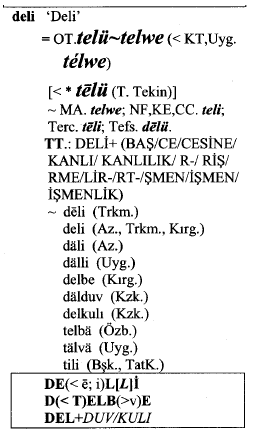
DELIRATIO is of Turkish origin and entered in Latin through Scythian Turks. Because it was not used in Latin before the 3rd century BC.

"Caelius Aurelianus (5th c AD), for instance, in the same passage where he reports the Herophilean (3rd c BC) description of a mental case, has DELİRATİO and Alienatio as Latin counterparts of two words used by Herophilus in his pioneer work on psychiatry, but because he regards the words as Synonymous"- (von Staden)
Laodikya'daki Herophilean okulu: “Örneğin Caelius Aurelianus'un (MS 5.yy), Herophileus'un (MÖ 3.yy) psikiyatri üzerine öncü çalışmasında bir akıl hastasını tarif ettiği aynı pasajda kullandığı iki kelimenin Latince karşılıkları olarak DELİRATİO ve Alienatio'yu kullanır, ama bu kelimeleri eşanlamlı olarak değerlendirir." -(von Staden)
DELİRATİO Türkçe kökenli bir kelimedir ve İskit Türkleri vasıtasıyla Latinceye girmiştir. Çünkü MÖ 3.yy'dan önce Latincede kullanımı yoktur.


"The intellect of mind by sorrow and dread
Deranged, the sad brow, the countenance
Fierce and delirious, the tormented ears
Beset with ringings."
Lucretius'un (99-55 BC), "De Rerum Natura"
In Latin it is used five (5) times as “delirium, delira, delirat, deliraque, delirantes” and in English translation it is used one (1) time as “delirious”.
"Aklın zekası keder ve korkuyla dengesiz,
Hüzünlü kaşlar ve çehre hiddetli ve çılgın (delirious),
İşkence gören kulaklar çınlamalarla dolu." (6.1174)
Lucretius'un (MÖ 99-55), "De Rerum Natura"
Latincesinde "delirium, delira, delirat, deliraque, delirantes" olarak beş (5) kere, İngilizce çevirisinde ise "delirious" olarak bir (1) kere kullanılmış.
SB
***

Türkic Substrate in English - N. Kisamov, 2013
Typological features of the Türkic languages include an agglutinative and exclusively suffixing word structure, sound harmony, verb-final word order, with dependents preceding their head, and use of numerous nonfinite verb constructions. These typological features are largely shared by the “Union of Uralo-Altaic language families”, and their elements are shared by a wide spectrum of the Eurasian and Native American languages.
Türkic languages, from the time of M. Kashgari, are divided into Western and Eastern Türkic languages.
The concept explores the Türkic–English morphological and lexical correspondences, and finds substantial traces of the Türkic substrate in English, potentially exceeding 30% of the English words used in the daily life. Of the English suffixes, 63% descend from the Türkic origin and remain morphologically active in forming English words.
Introduction
Forrer (1934) raised to a scientific discussion the observation that Germanic languages have a non-Indo-European substrate. Before that, the linguistic terrain belonged exclusively to the IE studies, based exclusively on the Family Tree model. All apples were falling at the root of the mama apple tree, and all saplings were its kids. The concept of substrate had infringed on that idyllic cartoon. Not only the mamma could grow in a banana grove, but the saplings could be various kinds of hybrids. The IE Theory was incessantly criticized and adjusted since its inception 2 centuries ago, and it is still lacking its fundamentals, such as a basic definition of what is and what is not Indo-European. An archaic notion that at some time there existed the PIE Adam and Eve speaking PIE language has been shelved long ago, pulling the rug from under a stipulation that at some time, somewhere, existed a community that used the PIE language, that the PIE is not a chimera. An evidence that PIE was not a compact language, and even not a language at all, pops up everywhere. Either lexically, phonologically, or morphologically, the IE Family Tree is perplexing. Perpetuation of the obvious etymological manipulations in support of the IE Theory have an opposite effect of seeding discontent.
To account for the contraventions, the model has to be disfigured with areal and contact interpretations fuzzed into the single-dimension paradigm, with optative inspiration that a three-dimensional amalgamation of Family Tree and Wave models may putatively address the nature and distribution of the correlations found among the IE languages. A few core languages provide well attested IE correlations, while the optimistic attribution of other languages to the family rests on statistically insignificant spotty evidence carrying mounds of interpretations. Aside from notoriously circular argumentation, the Family Tree model is bound with fluid interpretations of undefined parameters. Beyond a fuzzy notion that a majority (dubbed “consensus”) of some particular scholar community should be convinced on attribution of a language to a particular linguistic group, no defined criteria requires to meet any evidentiary specifications neither for pro nor for the con position. Conclusions are driven more by embedded ideological trends than by analysis. In the end, the PIE comes out as a clash of beliefs, rather than a clash of evidence. The problem remains a tag-of-war between competing opinions of the IE linguists.
An unexpected development came from the genetic studies that confirmed nearly complete wipe-out of the “Old Europe” population by the 3rd mill. BC, and its replacement by the mounted Kurgan nomads, long stipulated by the archeologists. A corollary of the population replacement by the waves of the pastoral Kurgans is that the Türkic languages of the Kurgans replaced, penetrated, and amalgamated with various European languages still in the 3rd mill. BC. In one form or another, the Türkic languages dominated most of the Europe as lingua franca, although demographically, the pastoral populations are always sparse. The “Old Europe” populations found a refuge in the Eastern Europe, from where in the 2nd mill. BC their descendants migrated to the South-Central Asia, and in the 1st mill. BC their other descendants bounced back to the Western Europe.
The IE migration to the South-Central Asia from the Eastern Europe is reflected in the diminished IE element in comparison with the Germanic languages (Prokosch 1939). The migratory flows, marked by distinct archeological traces, are independently corroborated by the genetics; their corollary defines the linguistic situation in the Eastern and Western Europe in the course of the 5th-1st mill. BC, they set up conditions for the following migrations preceding to and during the period of the Great Migration of People in the 1st mill. AD. Genetics helped to clarify the phenomenon of the Celtic migration, it corroborated archeological understanding of the Celts coming from Africa to Iberia at about 2800 BC, and traced their migration in a circum-Mediterranean movement to its source in the Eastern Europe of the 6th-5th mill. BC. Some linguistic elements, shared by the Eastern European languages in the 6th-5th mill. BC, survived both the overland and circum-Mediterranean movements of the Kurgans, and along with the later migrations and local vernaculars, they formed the Germanic substrate now found as linguistic vestiges.
Among potential Germanic substrate donors were suggested Fennic, Uralic (Wiik, 2002), Semitic (Vennemann, 2003), Tyrsenian (Steinbauer, 1999), but due to the episodic nature of the linguistic parallels, none of them gained an acceptance. Consensus remains with the S.Feist's assessment that about one third of the Proto-Germanic lexemes originated from a non-Indo-European substrate, and that the Germanic languages were a result of creolization and pidginization or koineization of that substrate with the later adstrate. Based on the combination of the archeological, genetic, and linguistic indicators, a concept was formulated and substantiated that the substrate of the Germanic languages was or were languages of the Türkic linguistic family, whose male speakers had a frequent marker of the haplogroup R1b, and who amalgamated with the local populations marked by the predominant male haplogroups I and N. The haplogroup I is identified with the native European populations, in particular the Balkans and Scandinavia, noted for their sedentary lifestyle, cereal farming, and military vulnerability. The haplogroup N is identified with the northern Eurasian Fennic populations, noted for their sedentary lifestyle, hunter-gatherer economy, spareness, and military vulnerability. The haplogroup R1b is identified with the Kurgan cultures, noted for their horse nomadic husbandry, high mobility, and high military aptitude.
The proposed concept disbands unsustainable IE etymologies, analyzes and explains the peculiar geographical linguistic distribution stretching from Northwest India up to the Pontic Steppe and on to the North Sea, corroborates archeological and genetical evidence of migrations and amalgamations, is in concordance with the documented history of the Eurasian Steppe and Northern European people, is in concert with historically attested ethnological and cultural distinctions, and is constructively helping to rid the swollen IE paradigm from unrelated burdens. It allows to discern particular groups and distinctions that contributed to the evolution of the English language. It uses hard statistical probability in lieu of warm linguistic feelings to discern correspondences from similarities, disbanding speculative justifications and accounting for wide distribution of similarities across Eurasia to the significant exclusion of the Near East that muddles the IE paradigm. It demonstrates partial adoption of a entire lexical, morphological and script paradigms that can be accounted for only through borrowing, attesting to demographic fusion. The material that forms the concept is not amenable to a flawless reverse interpretation. The circular logics, endemic in general linguistics and particularly universal in the IE methodology, is eschewed as counterproductive. It demonstrates futility of limiting the field to poorly substantiated and arbitrarily applied phonetical processes, to a reflexive exclusion of all other indicators. The concept strives to avoid elastic definitions drafted to include diverse material, it seeks to rely on attested evidence in lieu of theoretical concoctions. It allows to place the few core languages in a historical perspective, stripping them of a special ancestral status without throwing the baby with the water.
The converging genetic dating allowed to trace genetic markers in space and time, and draw observations about their migration, spread, and timing. According to Klyosov 2010, “The modern Uigurs, Kazakhs, Bashkirs, and some other peoples of Siberia, Central Asia and the Urals descend in part from the ancient R1b1 branch, and by now retain the same haplogroup for 16,000 years. The “Türkic-lingual” haplogroup R1b expanded from the South Siberia, where it formed 16,000 years ago, across the territories of the Middle Volga, Samara, Khvalynsk (in the middle course of river Volga) and the Ancient Pit Grave (“Kurgan”) archaeological cultures and historical-cultural complexes (8-6 thousand years ago and later, the common ancestor of the ethnic Russians with the haplogroup R1b1 lived 6,775 ± 830 years ago), northern Kazakhstan (for example Botai culture dated by the archaeologists 5,700 - 5,100 years before present (BP), in reality much older), passed through the Caucasus to Anatolia (6,000 ± 800 BP by the dating of R1b1b2 haplogroup of the modern Caucasians), and through the Middle East (Lebanon, 5,300 ± 700 BP; the ancient ancestors of the modern Jews, 5,150 ± 620 BP), and Northern Africa (Berbers of the R1b haplogroup, 3,875 ± 670 BP), crossed over to the Iberian Peninsula (around 4,800-4,500 BP, present day Basques 3625 ± 370 BP) and further on to the British Isles (in the Ireland 3,800 ± 380 and 3,350 ± 360 BP for different populations), and to the continental Europe (Flanders, 4,150 ± 500 BP, Sweden 4,225 ± 520 BP).” According to the archeological evidence systemized by M. Gimbutas, 1994, Europe also experienced three major Kurgan overland migration waves, some of them were repeat migrations into the same areas.
The dating of the Kurgan migration waves, produced by archeologists using radiocarbon analysis, is in concert with the genetic dating: wave 1 at c. 4400-4300 BC, wave 2 at c. 3500 BC or somewhat later, and wave 3 soon after 3000 BC; the circum-Mediterranean Celtic Kurgan wave reached Europe independently at 2800 BC. Along its route, the circum-Mediterranean wave remains archeologically unexplored. Between the 3000 BC wave and Sarmatian migrations of the 2nd c. BC, there is a historiographical lacuna, but considering the sequential waves of the Huns, Bulgars, Avars, Kangars-Bechens, and Oguzes of the 1st mill. AD, there is no reason to suspect an absence of the Kurgan migrations during the lacuna period. It is reasonably expected that the waves, separated by the timespans on the order of millenniums, were likely composed of linguistically differing tribes of the same linguistic family but complemented by different allies, were impacted by the specifics of their migration routes and their durations, and were bringing to the new territories their particularly distinct vernaculars. Although belonging to the same nomadic horse-breeding Kurgan historical-cultural complex, they possessed different technologies, starting with the Neolithic, and ending with the metals.
This detailed genetic picture provides an impetus for the linguistic studies. Presently, English is credited with approximately 800 Türkic cultural loanwords of mostly medieval Ottoman and Kipchak origin (Bikkinin I., 1998), of them about 250 are found in common English dictionaries, and are listed in the Wikipedia “List of English words of Turkic origin”. According to the Türkic substrate concept, a deeper linguistic layer forms the substrate layer of the Germanic languages, and particularly of the English language.
For the sedentary societies, the Kurgan expansion and population replacement, attested by the “killing fields” of the period between 4500 and 4000 ybp, would create a continuous chain of mutually incomprehensible vernaculars every 200 km. This value would not apply to the mobile nomadic society, where the linkages are much longer and alien encounters are much more frequent, resulting in more pronounced effect of linguistic leveling. Still, with the longitudinal distance of 55°, as depicted on the Conceptual map of Kurgan westward waves above, and the timespan of 2,500 years, the development of local Sprachbunds is unavoidable. Allowing a theoretical 5-fold increase in the linear spacing would divide the European theater into 10 conceptual Sprachbund areas, 5 areas wide and 2 areas across. Given the relative stability of the roots in the agglutinative languages, the interplay between these European Türkic Sprachbunds and later historical events that shaped various European languages would create a raster of allophones for each word, united by their origin from a small group of relatively close vernaculars, but at times barely recognizable.
The last Kurgan waves belong to the Iron Age, they are connected, in sequence, with the last northward movements of the Scythians coinciding with the formation and rise of the Roman Empire and with Kurgan migration from the Central Asia to the Urals. The Uralian Sarmat men were supplanted by the migrants, who inaugurated the Late Sarmatian Age. Retreating Sarmats overrun the N. Pontic Scythians, and expanded into the Central Europe, turning it into European Sarmatia described by Ptolemy and Strabo. In the process, Europe gained theretofore unknown nomadic people called Wendeln and Goths, Burgunds and Turings, and others that pushed out the old Scythian nomadic tribes into inaccessible Netherlands and Jutland. With the newcomers came their vernaculars, mixing, and amalgamation. The next Kurgan wave is known under the name of the Huns, although its bulk consisted of the Early and Late Sarmatians known under variety of names. With the Hunnic wave came more vernaculars, mixing, and amalgamation. From the Hunnic wave arose Anglo-Saxons, history becomes much less blurred, and we receive the first records on the languages of amalgamated nomadic peoples, in case of Anglo-Saxons and Goths a blend of recognizably Türkic and unrecognized local European languages that become known as Germanic languages.
From the same milieu of the Türkic and local vernaculars rose the Slavic languages. The next Kurgan wave was already termed Türkic, it brought along Avar, Bulgar, and Suvar Türks, and numerous tribal names, but their western influence did not extend much beyond the Slavic linguistic area. All subsequent Kurgan waves, those of the Bechens (aka Pecheneg), Oguzes (aka Torks and Türks), and Kipchaks (aka Polovetses) did not extend beyond Balkans. The last Kurgans that reached central Europe were a branch of Bulgar Onogurs with their allied Ugro-Finnic allies who took over Pannonia and formed the Magna Hungaria. The last Kurgan wave was that of the Chingizids, it was stopped at Adriatic and barely affected the Balkans. The Hunnic wave was the last one connected with the Türkic substrate of the English language.
The eventful life of the Kurgans shaped their languages. According to Turkologist S.E. Malov 1952, “Western Türkic languages show that they had very rich and long life, they experienced many different influences and other exposures. That could not have happened in a very short period. In the west, all settling of Türkic people from Central Asia that we know of (for example, the Huns, Mongols and Tatars, Kyrgyz) did not exert influence and shift toward Eastern Türkic linguistic elements that could be expected if here in the West have not been established the steady and well-ossified Western Türkic languages”. The western traces of the Türkic languages are deep and wide, so deep that they continue their active and productive life in the languages across much of the Europe, so wide that they could not have been wiped out by the pre-Industrial Age extermination campaigns. The traces are neither erasable nor falsifiable.
English has estimated 500,000 words, absorbed from every imaginable language; about 30% of the lexicon ascend to the Germanic, Celtic, and substrate portions; the unique words shared by English and individual Germanic languages serve as indicators of the colorful blend: 120 Anglo-Frisian words vs. 40 Friso-Scandinavian words. Thus, for example, the particular form sin “sinful” came from the Türkic exclusively via Frisian. Only a portion of the Türkic lexicon in the Anglo-Saxon vocabulary survived into English, numerous Anglo-Saxon Türkic words are absent in English, but at the same time English is endowed with numerous Türkic words not documented in the Anglo-Saxon lexicon.
The substrate of the Türkic origin may number only few hundred words, but they are the most important words: I, do, this, my, make, give, talk, eat, write, tell, kill, earth, time, day, dawn, body, and the little affixes that make English the English. They are also the most necessary and endearing household words: mommy, papa, baby, puppy, doll, lullaby, cry, hash, wake, fart, butt, son, girl, brother, cousin, kin, guest, say, tell, candle, loaf, In the G.Doerfer's classification, these words are “essential basic words”, essential for the daily life and for the substrate concept. So far, most of the Türkic words meet etymologists' blank eye, many appear from nowhere in the records of the late Middle Ages as a “folk speech”, which what they precisely were, the speech of the ingenious English folk little affected by the Lat. influence. Quite remarkably, some of these basic words echo in the Chinese and Korean, demonstrating their spread from one end of the Eurasia to another, which only the horse-mounted Kurgan nomads could feasibly achieve. That common thread once propelled a suggestion of Sino-Caucasian superfamily.
We do not know the names of the Kurgan nomads before 2200 BC, we know some names of these nomads from the Assyrian tablets ca 2200 BC: Guties, Turuks, Komans, Kangars; ca 1600 BC in China they are called Juns (Rongs) and Jous (Zhou); at approx. 800 BC in N.Pontic and Asia Minor they are called Cimmerians and Scythians; ca. 200 BC north of China they are called Huns, Juns, Tokhars (Yuezhi), Usuns, Saka, Kangars, and Tele; and in 200-400 AD they are called Huns in the west, in India, and across the eastern Eurasia, and Kangars and Usuns in the center of the Asia. After that, they continue to rush around Eurasia and build kurgans for their deceased for another 1,000 years, coming into the present.
English Türkic/Turkish
Adam Adam
Arthur Arthır/Artur
Brain Bein
Brother Birader
Cousin Qazin
Celt Kel /Keldi
God Kut (Holly)
Man Men
Me Min
Message Mushtu
Tumulus Tumlu
Latin and Türkic Languages
Numerous English words are ascribed to the Latin and Latin via French, implying that either the English did not have words for such concept at all, or that the Anglo-Saxon (OE) lexicon was fully supplanted. Numerically, the Romance strata in English is estimated to be on the order of 70%. However, an assessment of the set of the 450 Türkic-English cognate words cited below finds that much of the corresponding Latin vocabulary is related to the same Türkic substrate that formed the English lexis. Historically, such continuity is consistent with the thesis that most of the “Old Europe” population was vanished by the 3rd mill. BC, and from the 3rd mill. BC to the 1st mill. BC it was replaced by various Türkic populations and their varieties of the Türkic languages.
И хотя Латинский цитируется как мертвый, замороженный язык, цитируемые слова принадлежат живому языку, вобравшему множество Тюркизмов из Готского, Бургундского, и других средневековых языков кочевников. Веками, академический и экклезиальный Латинский сосуществовал рядом с Вульгатами, Латинскими языками народов. (Although Latin is cited as a dead, frozen tongue, cited the words of the living language, has absorbed a lot of Turkism Gotha, Burgundy and other medieval languages nomads. For centuries, the academic and ecclesial Latin coexisted next to the Vulgate Latin peoples.)
The Latin lexicon of the Türkic origin was superimposed, supplanted, and conflated with the same English innate lexicon of the Türkic origin, forming a local version of something like a European Türkic-based Sprachbund layer. The following table presents English-Latin-Türkic correspondences; it does not pretend for a full coverage of the apparent Turkisms in Latin; rather, it is a statistical indicator of the Türkic-Latin lexus (127 words) vs. the Türkic-English lexus (400 words): 32% of the sample. This number can't be applied to the whole body of the Romance in English, which is expected to be much diluted by various admixtures, and be smaller by an order of magnitude. Only in the context of the Türkic-Latin-English commonality it is a very significant number; the visible indicators point to the Latin and English Turkisms originating from much different versions of the Türkic vernaculars, likely also separated by a timespan measured in millennia, planted on completely different substrates, and compared with the geographically far remote OTD lexus recorded for a time period one millennium later in the English case, and a few millenniums later in the Latin case.
In all cases, a borrowing from Latin and English into Türkic is positively impossible, especially in case of the Central Asian and Far Eastern Türkic languages. In case of Uigur, for example, Uigurs are continuously attested in the Central Asia-Far Eastern region from the 3rd c. BC, before the rise of the Roman Empire on the other end of the Eurasia. Numerous Türkic tribes are attested still further east of the Uigurs. Neither Romans, nor English possessed the mobility of the mounted Türkic tribes, used the steppe belt as a transportation corridor, or are known for their mass migrations across Eurasia to effect such borrowing.
The quite substantial presence of Türkic–Latin–English lexical correspondences mocks the standing thesis that the Centum language group is devoid of the Türkic presence. The Centum group includes Italic, Germanic, Celtic, and Hellenic languages, and besides English and other Germanic languages, numerous cognates of the Türkic stems belonging to the Italic, Celtic, and Hellenic languages are cited below. Originally, the thesis may have reflected the true extent of the knowledge of its author, but the continuous recitation of the hollow thesis must be an embarrassing display of orthodox beliefs. The conundrum is not amendable: albeit in the past two centuries numerous modern languages underwent ethnical cleansing, it is impossible to mechanically cleanse the ancient Greek or Latin, their Turkism have been sown wide and deep, and grew deep roots.
English Latin Turkish
Arthur Arturius artur (v.)
Sanskrit and Türkic Languages
The IE linguistics holds Sanskrit as an IE language; the traditional IE theory claims its age at about 1700 - 1500 BC; one of the pillar tenets at the foundation of the IE theory was, and that is still holding, the great antiquity of Sanskrit; and Sanskrit was and continues to be held as closest to the PIE language. The opposition within and without IE linguistics disagrees with every tenet. Like with the Germanic and Russian non-IE listings, were compiled long lists of Vedic and Sanskrit non-IE words, believed to be of non-Aryan origin. Extensive lexical, phonological, structural, and morphological correlations were identified between the old and modern Indo-Aryan languages and the other non-IE languages of India, mainly Dravidian and Munda. The observed lexical and structural similarities are hardly traceable or attributable to borrowing, convergence, etc. Indian scholars challenge Eurocentric classification of Sanskrit as an IE language, asserting that it is a product of socio-politico-cultural circumstances. Some opposition supports a concept of “South Asia linguistic area” covering various Indian languages and language families.
Historical background attests to more than 2 millennia of the Türkic presence in the South-Central Asia, with a long list of ethnicities and polities, starting with Indo-Scythians and ending with the Moghuls, from whom Britain wrestled control of India. The linguistic traces of the Türkic presence are indelible in Indian languages, Cf. the Indian hallmark sari, the Türkic “wrapped”. In that respect, Sanskrit is consistent with the other Indian languages.
Germanic and Türkic Languages
There goes around a notion that Türkic-IE connection does not exist, that the IE could and was solely impacted only by the Ugro-Finnic group. In that scheme of geographical ethnography, Altai is too far from the European arena to possibly pass any borrowings into the IE languages. As a principle, alternate explanations are not considered, facts are viewed through a lens of preconception. This myth is solidly supported by a thorough disregard of linguistic reality. . In contrast with the IE etymologies, most of the Türkic borrowings, or rather sharings, are so transparent, it takes a certified blind to pretend not seeing them with a naked eye. The etymology of the Türkic substrate in English practically does not exist, most of the Türkic words in English are left without any, even most flimsy, explanation. Etymological dictionaries and encyclopedias state with a straight face an “unknown origin”, or at best lead to OGk. or OLat., like if they were there on the first day of creation.
The reality is much simpler than it is popularly presented, and at the same time much more interesting.
Rhotacism is one of the main traits that separate Oguz (-s-) and Ogur (-r-) languages, to a degree that these groups are defined as s-language versus r-language. This preeminent trait is continued in the Germanic languages, notable, among others, in the Dutch (Y-DNA R1b 70%, R1a 4%) -s plurals and (by rhotacism) Scandinavian (Swedes, Y-DNA R1b 17%, R1a 21%) -r plurals. The ratios of the Y-DNA components point that Y-DNA R1b marker is correlated with the -s- form, and Y-DNA R1a marker is correlated with the -r- form. The same separation appears among the Türkic ethnicities historically connected with the Oguz (Common Türkic) and Ogur (Karluk subgroup, Uigurs, Uzbeks) groups, and is supported by paleogenetic testing.
Tatsiz türk bolmaz bašsïz börk bolmaz
No Türks without aliens as no hats without head
Нет Тюрок без иноземцев, а шапки — без головы
(МК II 281)
Conclusions
At their core, the leading hypotheses on the substrate of the English language, and by extension of the Germanic languages as a group, turned out to lead nowhere. They were not able to demonstrate continuity in the morphological and lexical aspects, they were not able to attest continuity in the phonological aspect, and they were not able to present instances where the English and suggested substrate language use the same word in the same grammatical function and the same semantics.
The concept of the Türkic substrate does all of the above. In addition, it supports the existence of genetic connection between the Futhark alphabet and the Türkic alphabets, although its mechanism is yet to be analyzed, it demonstrates the common Türkic origin of the Latin and English linguistic building blocks, and it reflects the known development of the English language.
The Türkic substrate concept is based on the accumulated knowledge on the movement of the Kurgan people in the pre-historical and historical times, it is consistent with the findings of the archeology, genetics, and historical records. Moreover, it corroborates their findings, adding the linguistic aspect to the body of multi-discipline evidence. Composed in the 20th c. and widely popularized mantra on the Iranian-linguality of the Scythian and Sarmatian Kurgans (Scytho-Iranian Theory) stubbornly remained unsupported by the contiguous disciplines, including linguistics, it remained infertile in its insights, and conflicted with the historical records. Reverting back to the 2000-years old original concept of the Türkic-linguality of the Scythian and Sarmatian Kurgans restores concordance with the historical records, harmonizes the linguistic aspect with the other disciplines, allows a better understanding of the historical developments, and serves as a productive base for understanding of the substrate languages across Europe. By pinning down the Türkic portion of the substrate, it allows a deeper insight into the heritage from the times preceding the Kurgan waves.
In respect to morphology, the review of the modern English suffixes demonstrated that proportion of the suffixes inherited from the Türkic substrate stands at 63%, and in the Old English that proportion stood at 69%; the trend is consistent with the known development of the English language. Modern English is a product of perpetual creolization, pidginization, and blending of the linguistically incompatible mother languages, which in turn were products of perpetual creolization, pidginization, and blending. The loss of the substrate morphological structure is expressed in the reduction and contraction of the morphological elements, and in concomitant increase in the number of lexemes required to fill in the semantic void created by the morphological contraction. Studies of modern creole languages highlighted their proclivity for marginalizing morphological structures of the substrate languages in integrating substrate lexemes into the new pidgins. English does not stand out, it presents a handy example of that common morphological trend.
The review of the word usage frequency in modern English demonstrated that proportion of the Türkic substrate vocabulary in the modern English is no less than 30%. That means that about 1/3 of the passage spoken or written in modern English ascends to the Türkic substrate; counting the Türkic-derived morphological units in the same text would boost that rough estimate quite significantly.
The review of the modern English lexical units versus the Latin and the Türkic demonstrated that the Türkic substrate is present in both the Latin and English, while the phonetical differences point to separate and independent paths leading to the Latin and English. In the English substrate layer, the Latin Turkisms conflated and superimposed on the English Turkisms, in the end producing modern English words with roots in Old English, Latin, Latin via French, and ultimately in Türkic.
The substrate-derived English lexus is consistent with the migrations outlined by the archeology and genetics, it carries the marks of the migrations, and in some cases allows to draw suggestions about location and time of their earlier presence. Within the framework of the “Indo-European homeland”, such cases allow to corroborate postulations of the “Circumpontic” hypothesis (Merpert, 1974, 1976) and “Kurgan theory” (Gimbutas, 1964, 1974, 1977, 1980) about the importance of the Eastern Europe in the evolution of the “Indo-European” languages, without their fancied allusions to the “Indo-Europeans”, but with evolutionary perspective on the migratory processes that had the Eastern Europe as one of the staging stations on the way from Asia to the Atlantic.
The waves of the Gimbutas' “Kurgan theory” are specific episodes pertaining exclusively to the Eastern Europe/Central Europe scenery, they are an incomplete part of the overlooked general migratory processes with the preceding waves leading to the Eastern Europe, with the parallel paths traversing Anatolia to reach the Balkans and Iberia, and with reverse migrations. Having such omissions, the partial picture in inevitably faulty, and the confusion between separate migratory events in opposite directions and a millennium apart is not surprising. The horse was domesticated in the Northern Kazakhstan, the overlooked wave that brought domesticated horse to the Eastern Europe created conditions underlying the Gimbutas' “Kurgan theory”. Similarly, the migration stipulated within the “Anatolian” (or Neolithic Gap”) theory (Gamkrelidze and Ivanov, 1980, Renfrew, 1987, Safronov, 1989, Gray and Atkinson, 2003) is only a specific episode of the Eastern European parallel path traversing Anatolia to reach the Balkans and Iberia, the partial picture is inevitably faulty, and results conflict with Anatolia's role as a migratory corridor for particular migrants at a particular time. Within a larger framework, having accounted for the ample reverse migrations, and freed from the parochial biases of the “Indo-European homeland”, the theories' data is largely consistent with the linguistic and migratory processes.
Afterword
The term “substrate” in linguistics refers to an indigenous language that in the process of diffusion and convergence contributes features to the language of the later migrants. The defining characteristic of the language is its grammatical structure, in this case the Germanic grammatical structure which English lost relatively recently. The presence of the Germanic grammatical structure initially inherited by English indicates that Germanic languages inherited grammatical structure from their substrate language. That raises a question on the relationship substrate-adstrate in the Germanic languages, opens a gate for a possibility of relexification of the Germanic and English languages on the IE substrate base, and requires a close study. The Relexification Hypothesis stands in opposition to the Substrate Hypothesis.
The well-developed IE Theory happened not to have a key definition what constitutes the IE linguistic family, where are its boundaries, and what are the criteria defining what is and what is not IE. Personal intuition plays a role of defining criteria. Consensus does not extend beyond the name “Indo-European linguistic family”, its contents are undefined. The large proportion of English words that straddle credible IE cognates and Türkic cognates may be indicative of what the base definition of the IE linguistic family should be.
At the end of the 5th c. AD, Saxonia was located in the heart of the Europe, at the junction of Germany, Poland, and Czechia (Bohemia), adjacent, and probably a part, of the core Hunnic lands. It can be speculated that after the contraction of the Hunnic Empire, Saxonia came into being as a splinter of the Hunnic state, and possibly populated by a splinter Hunnic tribe lead by a splinter of the Hunnic dynastic clan Dulo. In support of this speculation can be cited vestiges of populations scattered in the nearby mountainous areas who connect their ethnic and historical origin with the Huns, the few literary references of the Huns remaining in that area, and details from the history of the Hungarian migration Honfoglalás to Pannonia and their interface with the local Türkic populations west of Pannonia. Tacitus located Saxes in Holstein, surrounded in the north by Angles in Schleswig and in the south by Angles in the basin of r. Weser, extending to Elbe (Angeiloi), in one continuous arc. Angles and Saxes fell under Hunnic supremacy at the turn of the 5th c., and two generations later started their expansion. They carried their Germanic language with the imbedded Türkic substrate not only to the British Isles, but to the Bohemia area, where their traces waned with time, and to the middle course of r. Elbe, where their traces survived into the present.
The continuity of the Celtic movement from the Iberia to the Central Europe and their eventual retreat to the northwestern fringes of the Europe is still unclear; the extent, details, and most cardinaly the composition of the Celtic migrations across Europe are blurred, and since English has a notable Celtic layer, understanding of its origin or origins would help in understanding linguistical processes. The Scandinavian spill into the continental Europe brought along to the continental Europe their language and genes, of which the Y-DNA Hg I was a major component. Clarification of the early Scandinavian demographic, linguistic, and genetic impact on the Anglo-Saxon and British Isles area may impact the historical picture of the English language development.
The distinct Anglo-Saxon language, perpetuated by the English language, has spread far and wide, first by colonial expansion, and lately as an international lingua franca. English preserved the language of the Eurasia, England preserved the Anglo-Saxon democratic traditions of the Eurasia, and they made them a heritage of the whole world. Numerous examples across Eurasia played out the same scenario: a relatively small group of nomadic horse breeders imposed themselves as ruling elite on an alien sedentary society, eventually adopting its language and creating a common syncretic religious ideology to cement their rule. Almost universally, the mechanism of the conquest was a peaceful marital union between the conquering and conquered elites. Invariably, the amalgamation of the languages reflects demographic and social situation, and creates a common lingua franca. Examples are plentiful, starting from Zhou in China and ending with Norman conquest of British Isles. In most cases, the new polities became known under the conquerors' name, like Tokhars, Kushans, and Russians.
In few cases, a double name includes both names from the previous cycle of amalgamation, like As-Tokhars, or both names from the latest compact, like Indo-Scythians. The Anglo-Saxons amalgamated on the continent, they migrated to the British Isles under a double name where the part Saxon appears to be a cognate of the names Scythian, Saka, Esgel, Eseg, and more; these non-native renditions reflected a stem depicted at times as S'k with a glottal stop, but it was probably closer to the syllable syc- in the word syconium, with the semi-consonant -y- like in the word eyes. The plural form of the ethnonym may attain native suffixes -aɣut/-an/än/-ɣut/-güt/-lar/-lär/-t or local plural markers, creating forms like Sykan (Saxon) and Saklar (Sekler). Traces of these processes have survived in the folklore of the tribes around Jutland and in the Norse sagas.
The blending of OE and Norman Romance is familiar to all students of English as a matter of fact, loanwords from Norman entered English and underwent phonetical changes without much to do about it, they did not originate a new linguistic law on phonetical adaptation that serve to discriminate between compliant and incalcitrant transformations, and to dismiss incalcitrant words as unrelated to the Norman; Anglo-Sax. turf and OFr. tourbe neatly occupy their appropriate spots on the descent tree without a need to conform to some linguistic law. In other words, no reconstructed OFr. form *tourbe is needed to arrive at turf, and any other allophone would be acceptable as long as the semantics proves a genetic connection. Going from the attested into unattested, however, requires conformance to the phonetical laws, and the semantically sound Türkic turan, turfan, or turmaq may be dismissed as gross noncompliants in spite of the convergent historical, archeological, and biological evidentiality. The resolution of the conundrum seems to be obvious: glotto-transformations are the consequence of the interplay of the historical, demographical, and linguistic factors, and not the other way around.
A comparative study of the western Türkic forms preserved in the European and especially in the Germanic languages may be helpful in resolution of ongoing linguistic problems, like the numerous occurrences of inconclusive translations from different alphabets, which may be confirmed using cognates in the European, Germanic, and western Türkic languages.
The review of the Türkic substrate in English allowed to discern some trends and make some predictions which underlying logics may or may not be consequently validated. One such prediction is that on closer examination, Latin would have more Turkisms with m-dialect than with the b-dialect. The specific testing results of this particular prediction, and other hypotheses may be helpful in archeology, genetics, linguistics, and Eurasian history.
Irek BIKKININ
TURKIC BORROWINGS IN ENGLISH
The work of Irek Bikkinin covers medieval borrowings. A small appendix below gives a sampling of much deeper layer, the full article is in the Turkic substrate in English posting.
Rassokha I.N.
Ukrainian pra-motherland of Indo-Europeans
I.N.Rassoha's work gives a general review of the Sredny Stog culture. Though the Sredny Stog culture is popularized in the countries of the Eastern Europe and by the preachers of N.Pontic origin of the Indo-European languages as a suspected ancestral home of these languages, ethnologically the Indo-European peoples are completely non-comparable with the Sredny Stog culture. Any other group of peoples has not preserve until historical times that complex of ethnologic parameters which defines the Türkic peoples: kurgan burials, tamgas, care after ancestors in the other world, horse-based nomadic economy and all tools for its functioning. The chapter from I.N.Rassoha's book gives archeological description of the emergence of this phenomenon. While obviously not a standard concept, this concept has found support among all involved disciplines: archeologists, physical anthropologists, ethnologists, historians, and linguists, not only among ethnically Türkic scientists and scientists involved in a Türkology, but also among other scientists not interested in pre-prejudiced solutions for the ethnic problems of other peoples.
There is another possible way of adoption of the Turkic words by the Old English as well as the Middle English – the Viking route.
Vikings for a long time – from the 9c until the 12c – actively contacted with Turkic peoples – Bulgars, Pechenegs/Besenyo/Bajinaks, Kypchaks, etc. And, apparently, they borrowed some notions from them. Vikings, known as the sea nomads, warriors and merchants, began their expansion only in the 800 AD, but it is known that already in the 5c they highly valued Hunnish swords . The recent research shows that Vikings’ ancestors lived in the Don river basin, and left the region only in the 4c AD, supposedly forced out by the Turkic tribes. During the epoch of the Scandinavian Reign of England (9-12cc) , the Scandinavian language of the Vikings had a strong influence upon English.
In the 9-12cc the Turkic words penetrated English also through the Old French, which at the time was spoken by all the English aristocracy and their servants and warriors. Direct contacts of the English and Turkic peoples were resumed again during the Crusades, in which the English nobility participated along with their warriors. From the 1096 to 1270 AD, Europeans undertook eight Crusades to Palestine “to free the God’s coffin” and “to recover the Holy Land from the Muslims”.
The Crusades had positive consequences for the European culture. In the West, people began to wash hands before meals, learned how to use knives and forks, began to take hot baths, learned to change clothes and underclothes. Europeans began to grow rice, buckwheat, lemons, apricots, watermelons, to use cane sugar as food, learned to manufacture silk and mirrors and improved the quality of metals they produced.
or
"all agglutinative languages are also syntactically related to one another and thus must originate in Sumerian."
"Scientific research has clearly demonstrated , that the ancestors of Chuvash people is the Turks and they came here from Central Asia. Chuvash language takes place in Turkish language. The dialects which is distant to your language have common ancestors in language in fact.
Oghuz who lived in the Altai shaped the Chuvash language. In 1000 BC these tribes were divided. A number of Oghuz tribe, had relationschip with the Indo-European language, the letter "R" and "L" exchange in time. Over time this Oghuz tribes known as Ogur Turks. Turkish dialects has been classified in both arms, "Z" letter into "R" and "Ş" letter into "L" . Based on this, the "Z" "Ş" dialect Eastern Turkish group, "R" "L" dialect Western Turkish group.
Our ancestors takes place in the second group, that's why become Oghuz into Ogur. Ogurs are the progenitors of the Huns. When Mete Han establish the Hun Empire (Mete Han, the founder of Xiongnu Empire, ruled from 209 BC to 174 BC), his army was of the same root, but it consisted of people who speaks different dialect. Mete Han chose the language of Ogur, which is close to the present Chuvash Turkish, to unite the army. The westward migration of the Huns in the 5th c.AD, moved our language with them. We taught the peoples in this region this language, but we have received from them words and grammatical editing also.
In summary, we Chuvash people speak our common ancestor, language of the Huns. Chuvash language is the only living language of Ogur language. Close relatives languages which is Hun, proto Bulgarian and the Caspian languages are dead now.
When you look ethnically, as the Asian roots of the Chuvash communities, has also close blood ties to the Finno-Ugric roots. Great Bulgarian Khanate, established in the north of the Black Sea in the 7th century, and the Khanate of the Volga Bulgars, our ancestors did that. European Huns, Bulgarian Turks community came out with a result of mixing of Ogur (Oghuz Turks) and Sabir (Sabar / Suvar Turks) . We established, the biggest pieces of these states in the steppes, we are the one of the constituent parts.
In the period of the Volga Bulgars Khanate, Sabir (Sabar/Suvar Turks) peoples and the people living around the city, during the Mongolian invasion, went to north and came here and they maintained their culture. We moved to the present day the legacy of our ancestors, despite all adversities and have appeared on the scene as the Chuvash. Volga Bulgars State language was a great effect to the Slavs, Hungarians, Mari and Udmurtia language.
What I'm telling you is, you can not do research today without knowing Chuvash Culture, because many culture have effect in Russia and Eastern Europe with the basis of the Chuvash history and their ancient culture "
Prof. Yegorov Nikolay Ivanovich
historian - Chuvashia
K.Gajendra Singh
CONTRIBUTION OF TURKIC LANGUAGES IN THE EVOLUTION
AND DEVELOPMENT OF HINDUSTANI LANGUAGES/detailed link
"Although the influence of the Turkic languages on Indian languages began in all seriousness from 11th century AD onwards to which we will come to later, various Turkic tribes began their interaction with Hindustan much earlier than that. After the collapse of Mauryan Empire in 3rd century BC, a number of Central Asian Turkic tribes, known as Sakas in India and Scythians in West, came to Hindustan and settled down there."....
"In the medieval history of Hindustan, the Turkic tribes played a major role among the Muslim conquers and rulers who came and made India their home."...
"It has been rightly claimed by many scholars in South India that a considerable process of development and even preservation of Hindustani took place in Deccan where it came to be known as Deccani, although the seeds of the birth of the language had been sown in North India from where it was taken to Deccan by Muslims conquers starting with Turkish Khilji (Halac) rulers and later Tughlak (again Turkish) rulers; Muhammed Tughlak even shifted his capital to the South for some time. Later a large number of kingdoms by Turkic tribes, in which they formed a fairly large proportion of the elite, were established in South India, i.e Bijapur, Golcunda, etc. When Allaudin Khilji conquered Deccan, the appointed Turks as chiefs for each villa e to look after its security, safety and administration. Most of them called their relatives to assist them. Thus both in the beginning of the evolution of Hindustani in the North and later in its further development in Deccan, a majority of the elite was of Turkic origin who while using Persian for administration must have used Turkish at inter-personal level and thus helped continue evolution of Hindustani in its various forms. The Deccani period also saw influx into Hindustani of not only Dravadian words but also its influence on its grammar and syntax and vice versa. We might even say that the Deccani period probably saved Hindustani from becoming totally Persianised as perhaps happened to it at many places in North India."...
"It has been estimated that Hindustani and Turkish have thousands of words in common, mostly from Persian and Arabic, Some estimates put them around three to four thousand, with over five to six hundred words of Turkish origin in Hindustani. The comparison is basically with the Republic of Turkey's Turkish (of Oguz family), which since 1930s has been purged of many Arabic and Persian words. Perhaps the number of common words between Hindustani and Turkish as spoken in East, i.e. Uzbekistan and East (Uighur and Cagtai family) could, perhaps, be more. Some examples of Turkish words in Hindustani are: Top, Tamancha, Barood, Nishan, Chaku, Bahadur, Begum, Bulak, Chadar, Chhatri, Chakachak, chikin (embroidery), Chamcha, Chechek, Dag, Surma, Bavarchi, Khazanchi, Bakshi (accountant), Coolie, Kanat, Kiyma, Kulcha, Korma, Kotwal, Daroga, Koka, Kenchi, Naukar, etc. Obviously, the number of Turkigh words in Hindustani is not as large as that of Persian and Arabic, because, the latter was the language of the Holy Koran (although Seljuk Turk rulers in Asia Minor and Iran had discouraged use of Arabic except for religion), which exercised influence over all believers and the former was the language of administration and aristocracy. I presume studies on the influence of Turkish on the Persian language and Arabic, have been done."
"Hindustani has surprising similarity in Grammar and Syntax structure with Turkish, though origins of both the languages are from different language families. "
Do not ignore Turkish Language and her influence on other languages.


