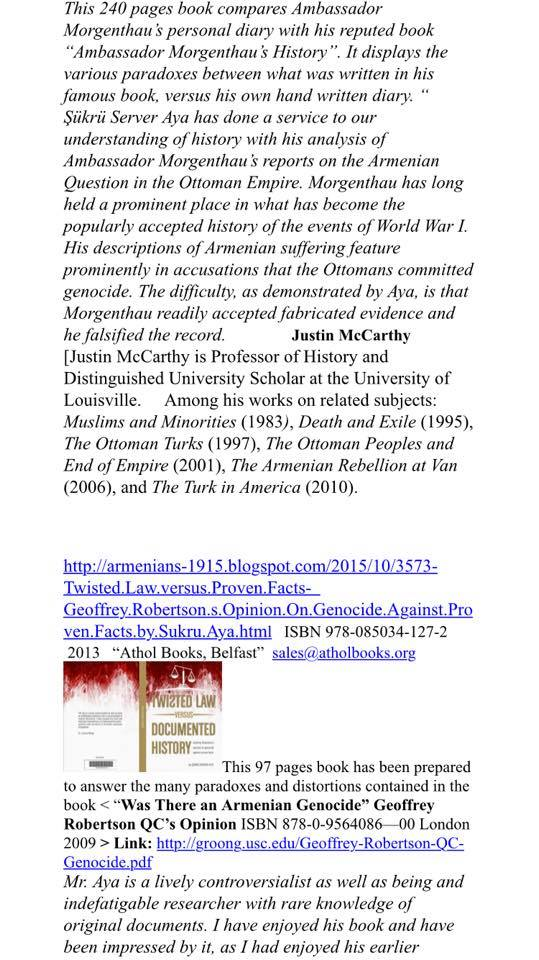
The Armenian allegations related to the relocation of Armenians during the beginning of First World War, mainly built on the book titled “Ambassador Morgenthau’s Story”written by so-called Mr. Henry Morgenthau Sr. . Actually the book was written by the Pulitzer Prize winner of the era Mr. Burton J. Hendrick. He is the ghost writer of this doubtful book and received a very huge lump sum of money from Mr. Morgenthau for his very professional, devoted and rapacious services.The fact is that Ambassador Morgenthau officiated as an US Ambassador in Istanbul from late 1913 to early 1916 but never travelled eastwards on the overland. His book is totally based on hearings and makeup stories created by the two Armenian US Embassy employees. No information in this book is based on any official document released by any neighboring country to the Ottoman Empire or even the US Senate or Congress.When this book is checked against Mr. Morgenthau's Diary, it can be clearly observed by anybody that it includes made up stories rather than reflecting the true lifememories.This paper, based on information excerpted from the non Turkish or non Ottoman formal documents and/or official releases, tries the bring into life what happened actually during this era.
INTRODUCTION
The Armenian allegations on the matters related to relocation of Armenians in the year 1915,mainly based on two books. One of these two books is titled "Ambassador Morgenthau's Story". It is said written by the USA Ambassador to the Ottoman Empire Mr. Henry Morgenthau Sr., published in the year 1918 at New York by the publisher Doubleday, 407 pages. The other book is called in short "Blue Book", titled "The Treatment of Armenians in the Ottoman Empire, 1915-1916 : Documents Presented to Viscount Grey of Falloden by Viscount Bryce". It is written by the British Historian Arnold J. Toynbee and viscount James Bryce, published in the year 1916, by H.M. Stationary Office, London and Sir Joseph Causton & Sons, London.
ARNOLD J. TOYNBEE'S BLUE BOOK
This book will be studied in depth in another paper and is not the core subject of this paper.
As a short brief to the researchers and academicians, it is clearly understood from the confessions of Toynbee that the "Blue Book" was fabricated by himself on the encouragements of Viscount James Bryce to serve the interests of Great Britain in Middle East during World War I. Author Şükrü Server Aya, in the page 7 of his book titled " Preposterous Paradoxes of Ambassador Morgenthau, explaines the the reason of fabricating the Blue Book as below;
"Actually the Blue Book was hurriedly prepared to divert the attention of the USA and the neutral countries from the massacres that the Russians had undertaken in Poland on the Jews!. When the war started Germans made the first attack in Russian territory and when they witnessed the Russian massacres on the Jews, they asked reporters from USA to comeand see with their own eyes!. Britain of course did not want their ally Russia to appear asbarbarous, and they immediately shifted the "massacre stories" from Jews to Turks who were already reputed for their criminality! The trick worked; the Russian massacres were quickly forgotten and replaced by Turkish ones on Armenians in the front pages of newspapers!"
Arnold Toynbee confessed in a later work that the “Blue Book” was a piece of war propaganda (Toynbee, 1992).
He coedited the Blue Book (Bryce, 1916) and later, after decades wrote " In the redistribution of Near and Middle Eastern Territories, the atrocities which have accompanied it from the beginning have been revealed in their true light, as crimes incidental to an abnormal process, which all parties have committed in turn, and not as the peculiar practice of one denomination or nationality." (Toynbee, 1922)
Toynbee, on his final statement on the matter, stated as: "Armenian political aspirations had not been legitimate. … Their aspirations did not merely threaten to break up the Turkish Empire; they could not be fulfilled without doing grave injustice to the Turkish people itself."(Toynbee, 1967)
After World War I, U.S. high commissioner and then-ambassador to Turkey Adm. Mark Bristol (Evans, 1965), in the year 1920 sent a cable to the State Department stating: " While the Turks were all that people said they were, the other side of the coin was obscured by the flood of Greek and Armenian propaganda painting the Turks as completely inhuman and undeserving of any consideration while suppressing all facts in favor of the Turks and against the minorities."
It is absolutely clear that he fabricated this book to serve the needs of Great Britain and createa base for the British to streng then their excuse to step in to Middle East. This book will behandled in depth in another paper.
PERSONS RELATED WITH THE BOOK TITLED "AMBASADOR MORGENTHAU'S STORY"
Ambassador Henry Morgenthau Sr.
Born on April 26, 1856 in Mannheim, Grand Duchy of Baden, Germany and died on November 25, 1946 in New York City, and was buried in Hawthorne, NY. He was the 9th children of 11 of an Ashkenazi Jewish Family. His father was Mr. Lazarus Morgenthau, a rich cigar manufacturer and mother Mrs. Babette Morgenthau. Mr. L.
Morgenthau owned cigar factories in Mannheim, Lorsch and Heppenheim. When the German tobacco exports to USA get hard by the 1862 tariff after the Civil War, all of his 3 factories closed down and the family decided to emigrate to New York, USA. Henry Morgenthau received his BA from City College in New York and graduated from the Law School of Columbia University. While practicing as a lawyer, he foresaw better earnings in real estate and made a substantial fortune (Balakian, 2003) from various investments onreal estate. In 1882 he married to Josephine Sykes and had four children named Helen, Alma, Henry Jr. and Ruth. With the support of his financial wealth he became the leader (Oren, 2007) of the Reform Jewish Community in New York.
During his leadership Henry Morgenthau met the than President of USA Thomas Woodrow Wilson in 1911 at an activity of the Free Synagogue Society (Balakian, 2003). His generous and bounteous contributions to Wilson's election campaign in 1912, rose his position in Democratic party and role in American political life. His contributed a mere $ 30,000 (Aya, 2013) to Wilson's campaign in 1912, equivalent of $ 2,527,646 (Based on $/Gold ratio in the year 1912 and 2013) of the year 2013. On the impact and wake of this handsome largesse and his successful efforts on raising money for the election campaign, he deeply expected a seat in the cabinet but offered the post of United States Ambassador to Ottoman Empire. The President's assumption was that Jews were only hugged by Ottoman Empire on their exile from Europe and they could form a bridge between Ottoman Muslims and Christian Americans.
Morgenthau initially refused the offer but with the incitement of his close friend Rabbi Stephen Wise and a trip to Holy Land he accepted (Balakian, 2003) the offer. He arrived to Istanbul on November 27, 1913 and served till February 1, 1916. He was the second Jewish USA Ambassador to Ottoman Empire and succeeded by another Jewish Ambassador Mr. Abraham Elkus (Aya, 2013). During his 780 days long diplomatic mission in Istanbul, Ambassador Morgenthau spent most of his time on the welfare of the Jews in Palestine although he wasn't a Zionist (Oren,2007). He handled huge sums of money in receiving, exchanging and transferring for the Jews in Palestine or around.
Ambassador Henry Morgenthau, during his 780 days of diplomatic mission in Istanbul, did not even travel ten miles out of the city to any countryside village, except a few on the Bosporus and the Belgrade Forest where he and his friends frequently went horse riding. The only trip he took was in March 1914 by ship to Greece and from there to Egypt, Holy Lands and cities around in Palestine and Beirut as the last stop. From Beirut he took a yacht named Scorpion and sailed to Mersin, Antalya, Rhodes, Smyrna and finally arrived to Istanbul in late April (Aya, 2013). It was like a cruise holiday and he never rode on a horse or a car on the soil of Ottoman Empire. He did not travel eastbound, never went further than 10 miles east of Skudari (Üsküdar) and did not visit the eastern regions of Anatolia.
Morgenthau returned to the United States in 1916 and for the remainder of the war years he dedicated himself to raising funds for the Jews in Palestine. In 1918 he published Ambassador Morgenthau's Story, a memoir of his years in Turkey.
USA President Thomas Woodrow Wilson
Wilson's full biography can be obtained from the site of White House (Biography, 2013). The biography states as " He was born in Virginia in 1856, the son of a Presbyterian minister who during the Civil War was a pastor in Augusta, Georgia, and during Reconstruction a professor in the charred city of Columbia, South Carolina. After graduation from Princeton (then the College of New Jersey) and the University of Virginia Law School, Wilson earned his doctorate at Johns Hopkins University and entered upon an academic career. In 1885 he married Ellen Louise Axson. Wilson advanced rapidly as a conservative young professor of political science and became president of Princeton in 1902. He was nominated for President at the 1912 Democratic Convention and served as the President of USA from 1913 to 1921, died on February 3, 1924. (White House, 2013)"
The related parts of his life to the era was his overwhelmed Christianity disciplined upbringing by a Presbyterian minister father and a Presbyterian minister's daughter as the mother. Consequence of this upbringing made him to believe strongly that Islam and the Moslems were the primary enemy of Christianity and Christians. His relation with the Armenians was due to the strong financial support he received from the"Armenian Lobby" during his presidential campaign and the strong belief that Armenians and Greeks lost their lives in huge numbers for the sake of Christianity on numerous struggles with Moslems, especially in Anatolia.
Wilson's rejection to film the book
Doubleday, Page & CO. published the book in October 1918 and the sales passed 20,000 within 8 months (Heath, 1990). The sales and the impact of the book on the mass of Americans were beyond the expectations and in the summer of 1918 Morgenthau received an offer from Holywood to convert the book to a moving picture (Heath, 1990).Morgenthau proudly conveyed the offer of Holywood to President Wilson for his consent expecting his praises on top as well. President Wilson sent him a letter disapproving the conversion of the contents of the book to a moving picture, stating:
“I appreciate your consulting me about the question whether the book shall be translated into motion pictures, and I must frankly say that I hope you will not consent to this...Personally I believe that we have gone quite far enough in that direction.. It is not merely a matter of taste, —I would not like in matters of this sort to trust my taste,—but it isalso partly a matter of principle... There is nothing practical that we can do for the timebeing in the matter of the Armenian massacres, for example, and the attitude of the country toward Turkey is already fixed. It does not need enhancement.” (Heath, 1990)
From this paragraph of Wilson's letter to Morgenthau, it is clearly obvious that to turn the Americans against Turks and Germans and get the approval of US people on the US Army to enter the World War I, the book is fabricated according to the instructions of President Wilson, the needs of USA Government and book of Morgenthau did very well. The goal was accomplished and no further reinforcement is needed on the matter. Accordingly the fabrication was very successful and a further step for enhancement might lift the veil of the invented story.
Robert Lansing
Another main actor or star of this fabricated book was the than "USA Secretary of State, Mr.Robert Lensing". At the President Wilson's behest he proof read all the chapters, as soon as they were edited (Heath, 1990). He played the key role on what to be included and not in the chapters of the book. Prof. Dr. Heath W. Lowry defined his role based on the letters Mr. Lensing and Ambassador Morgenthau exchanged during the gestation period of the book. Prof. Dr. Heath W. Lowry, on pages 10 & 11 of his book in ebook form, titled "The Story Behind Ambassador Morgenthau's Story" defines this relation as follows:
[ a) Lansing to Morgenthau letter of April 2, 1918, in which the Secretary states: “I am returning here with the first installment of the proof of your book which I have read with particular interest... I have made various marginal notes suggesting certain alterations or omissions in the text before publication and I trust that you will agree with these suggestions;”
b) Lansing to Morgenthau letter of April 27, 1918, accompanying another segment of the draft manuscript “accompanied by a few suggestions which after careful consideration we venture to propose;”
c) Lansing to Morgenthau letter of August 29, 1918, together with proof sheets and more suggestions;
d) Lansing to Morgenthau letter of September 17, 1918 with “suggestions and remarks,”
e) Morgenthau to Lansing letter of September 22, 1918 asking permission to acknowledge in the Preface to the published book, his appreciation for the “trouble taken by the Secretary of State Robert Lansing in reading the manuscript and of the many valuable and wise suggestions he has made;”
f) Lansing to Morgenthau letter of October 2, 1918 declining Morgenthau’s wish to acknowledge his assistance with the book on the grounds “that on the whole it would be advisable not to mention my name in connection with the book.” (FDR:HMS-Box No.12)
When one recollects the fact that prior to beginning his project, Morgenthau received the written blessings of the President of the United States, Woodrow Wilson, and, that as the work progressed, each chapter received the personal stamp of approval of the U.S.Secretary of State Robert Lansing, it is clear that Morgenthau’s book may be said to bear the imprimatur of the United States Government. ]
Hagop S. Andonian
One of the two fabulists of the book. A dedicated anti-Turkish Armenian native of Istanbul working in the USA Embassy in Istanbul as the Dragoman or the translator. According to a letter written by Morgenthau to his wife on July 15, 1914, Andonian was at that time studying in Robert College at Istanbul (FDR: HMS — Box No.5). From Ambassador Morgenthau's diary, it is understood that Andonian edited most of the memoirs took place in the diary as per his imagination and ability of creating fables. Ambassador Morgenthau wrote in his diary " I have really found it impossible to sit down and dictate a letter quietly. So, I have instructed Andonian to take my diary and copy with some elaborations of his own. Of course this relieves me all responsibility for any error" (Aya,2013).
It is quite clear from this memoir in his diary that Ambassador Morgenthau actually handed over his diary to Andonian and most of the time he created the fables, some in Istanbul and some probably in New York prior to publication. Ambassador Morgenthau took him along with to USA after completing his mission in Istanbul.
On January 9, 1918 Mr. Morgenthau addressed a letter to Mr. B. Long the Assistant Secretary of State responsible from the enlisting, asking a deferment from the military service for Andonian. The following paragraph takes place in this letter. “You probably know that with the approval of the President, I have undertaken to write a book. Mr. Andonian is assisting me in the preparation of that work and owing to his intimate knowledge of the east and his unusual experience, his services to me are really incdispensable.” (Aya, 2013), (Heath, 1990), (LC:PHM- Reel No.8)
Andonian started working on the book titled "Ambassador Morgenthau's Story" on January 9,1918 (Heath, 1990). From Ambassador Morgenthau's Diary for the year 1918, it is understood by the below notes that the Ambassador Morgenthau, Andonian and journalist Hendrick worked together for months to makeup this fable. Note dated April 26, 1918: "Dictated at Yale Club to Andonian and examined galley proofs of second installment next book." (Heath, 1990), (LC: PHM-Reel No.6) Note dated April 17, 1918: "Dictated all day to Andonian and Hendrick." (Heath, 1990)
Arshag K. Schmavonian
The second fabulists of the book and the right hand of Ambassador Morgenthau. A native anti-Turkish Armenian, who was employed by the USA embassy in Istanbul as the interpreter. He spoke perfectly well of Ottoman, Greek, English, French and Armenian. He accompanied Ambassador Morgenthau in all his meetings with Ottoman high level bureaucrats and officials (Heath, 1990). He depended so much on him that he acknowledged this particular act with solidarity as "“It will be my duty to dive into the very heart of things surrounding me. With the help of the Legal Adviser of the Embassy, Mr. Schmavonian, who knows the Orient so well, I shall be able to master the task in a more or less satisfactory manner in a few weeks.” (Heath, 1990)
He joined all the official and business meetings with American businessman and missionariesand also assisted Ambassador Morgenthau to write his cables to State Department in USA. Through Schmavonian, Morgenthau receives a visit from Zenop Bezcian, representative of Armenian protestants on Sept 26, 1915 and notes down the conversation in full into his diary (Aya, 2010).
Zenop Bezcian reports to him that "Armenians at Zor were fairly well satisfied: they have already settled down to business and are earning their livings". Morgenthau notes down these words of his own in his diary " those were the first ones that were sent away and seem to have gotten there without being massacred. He gave me a list where the various capms are and he thinks that over 500,000 have been displaced. He was most solicitous that they should behelped before winter set in" (Heath, 1990). After the cut off of the relations between USA and Ottoman Empire, Mr. Schmavonian transferred to USA in the fall of 1917 and worked in the State Department as the "Special Advisor" till his death in the beginning of year 1922 (Heath, 1990).
Burton J. Hendrick
He was born in New Haven, Connecticut on 1870. He completed his higher education in Yale University and received his BA in 1895 and his master's in 1897. He worked as the editor of "New haven Morning News" and as a writer in The NewYork Evening Post" and "The New York Sun". In 1919 he began writing biographies. On 1921 he received the Pulitzer Prize for the book titled "The Victory at Sea" on 1923 for the book titled "The Life and Letters of Walter H. Page" and again on 1929 for book titled "The Training of An American". He is the ghost writer of the book titled "Ambassador Morgenthau's Story" and well paid for his good service and outstanding wording (Letter, 1918).
He received two-fifths of any profit that came from the publishers until the first Ten Thousand US dollars collected, than a further Five Thousand Dollars, totaling a mere fifteen Thousand US Dollars ($15,000) which is equivalent of $1,263,823 of the year 2013. Burton J. Hendrick, couple months before his death disclose his ghost writing to historian Alan Nevins by stating (Footnote 43) " I had one job of ‘ghosting.’ That was the elder Henry Morgenthau’s Reminiscences. That book created quite a good deal of interest. I worked with Henry all the time. He was an Interesting character. Henry Morgenthau was a very capable person, very chummy and good natured and was a very successful man. He, of course, made a great fortune here in New York in real estate...The writing of my books on Sims and Morgenthau was very Interesting—more or less of a job...” He died on 1949.
DECLARATION (New York Times, May 19, 1985) MADE BY THE AMERICAN ACADEMICIANS
(Washington Post, Sunday, May 19, 1985)
PUBLISHED IN " THE NEW YORK TIMES" AND "THE WASHINGTON POST" (Aya, 2010)
ATTENTION MEMBERS OF THE U.S. HOUSE OF REPRESENTATIVES (May 19, 1985)
The undersigned (A Fabricated Genocide) American academicians (The other side of the falsified Genocide) who specialize in Turkish, Ottoman and Middle Eastern Studies are concerned that the current language embodied in House Joint Resolution 192 is misleading and/or inaccurate in several respects.
Specifically, while fully supporting the concept of a “National Day of Remembrance of Man’s Inhumanity to Man,” we respectfully take exception to that portion of the text which singles out for special recognition: “. . . the one and one half million people of Armenian ancestry who were victims of genocide perpetrated in Turkey between 1915 and 1923 . . .. ”
Our reservations focus on the use of the words “ Turkey ” and “genocide” and may besummarized as follows: From the fourteenth century until 1922, the area currently known as Turkey, or more correctly, the Republic of Turkey, was part of the territory encompassing the multi-national, multi-religious state known as the Ottoman Empire. It is wrong to equate the Ottoman Empire with the Republic of Turkey in the same way that it is wrong to equate the Hapsburg Empire with the Republic of Austria. The Ottoman Empire, which was brought to an end in1922, by the successful conclusion of the Turkish Revolution which established the presentday Republic of Turkey in 1923, incorporated lands and people which today account for more than twenty-five distinct countries in Southeastern Europe, North Africa, and the Middle East, only one of which is the Republic of Turkey. The Republic of Turkey bears no responsibility for any events which occurred in Ottoman times, yet by naming ‘Turkey’ in the Resolution, its authors have implicitly labeled it as guilty of “genocide” it charges transpired between 1915 and 1923;
As for the charge of “genocide” no signatory of this statement wishes to minimize the scope of Armenian suffering. We are likewise cognizant that it cannot be viewed as separate from the suffering experienced by the Muslim inhabitants of the region. The weight of evidence so far uncovered points in the direct of serious inter communal warfare (perpetrated by Muslim and Christian irregular forces), complicated by disease, famine, suffering and massacres in Anatolia and adjoining areas during the First World War. Indeed, throughout the years inquestion, the region was the scene of more or less continuous warfare, not unlike the tragedy which has gone on in Lebanon for the past decade. The resulting death toll among both Muslim and Christian communities of the region was immense (1) . But much more remains to be discovered before historians will be able to sort out precisely responsibility between warring and innocent, and to identify the causes for the events which resulted in the death or removal of large numbers of the eastern Anatolian population, Christian and Muslim alike.
Statesmen and politicians make history, and scholars write it. For this process to work scholars must be given access to the written records of the statesmen and politicians of the past. To date, the relevant archives in the Soviet Union, Syria, Bulgaria and Turkey all remain, for the most part, closed to dispassionate historians. Until they become available, the history of the Ottoman Empire in the period encompassed by H.J. Res. 192 (1915-1923) cannot be adequately known. We believe that the proper position for the United States Congress to take on this and related issues is to encourage full and open access to all historical archives and not to make charges on historical events before they are fully understood. Such charges as those contained H.J.Res. 192 would inevitably reflect unjustly upon the people of Turkey and perhaps set back progress irreparably. Historians are just now beginning to achieve in understanding these tragic events.
As the above comments illustrate, the history of the Ottoman-Armenians is much debated among scholars, many of whom do not agree with the historical assumptions embodied in the wording of H.J. Res. 192. By passing the resolution Congress will be attempting to determine by legislation which side of the historical question is correct. Such a resolution, based on historically questionable assumptions, can only damage the cause of honest historical inquiry, and damage the credibility of the American legislative process.
Signatories to the statement on H.J. Res. 192 addressed to the members of the U.S. House of Representatives
RIFAAT ABOU-EL-HAJ, Professor of History, California State University at Long Beach
SARAH MOMENT ATIS, Professor of Turkish Language & Literature, University of Wisconsin at Madison
KARL BARBIR, Associate Professor of History, Siena College (New York)
ILHAN BASGOZ, Director of the Turkish Studies Program at the Department of Uralic & Altaic Studies, Indiana University
DANIEL G. BATES, Professor of Anthropology Hunter College, City University of New York
LUKE BATES, Professor of Art History Hunter College, City University of New York
GUSTAV BAYERIE, Professor of Uralic & Altaic Studies, Indiana University
ANDRAS G. E. BODROGLIGETTI, Professor of Turkic & Iranian languages University of California at Los Angeles
KATHLEEN BURRILL, Associate Professor of Turkish Studies, Columbia University
TIMOTHY CHILDS, Professorial Lecturer SAIS, Johns Hopkins University
SHAFIGA DAULET, Associate Professor of Political Science, University of Connecticut
RODERIC DAVISON, Professor of History, George Washington University
WALTER DENNY, Associate Professor of Art History & Near Eastern Studies University of Massachusetts
Dr. ALAN DUBEN, Anthropologist, Researcher New York City
ELLEN ERVIN, Research Assistant Professor of Turkish, New York University
CAESAR FARAH, Professor of Islamic & Middle Eastern History, University of Minnesota
CARTER FINDLEY, Associate Professor of History, The Ohio State University
MICHAEL FINE, Professor of History, College of Charleston
ALAN FISHER, Professor of History, Michigan State University
CORNELL FISCHER, Assistant Professor of History, Washington University (Missouri)
PETER GOLDEN, Professor of History, Rutgers University, Newark
TOM GOODRICH, Professor of History, Indiana University of Pennsylvania
ANDREW GOULD, Ph.D. in Ottoman History, Flagstaff, Arizona
WILLIAM GRISWOLD, Professor of History, Colorado State University
TIBOR HALASI-KUN, Professor Emeritus of Turkish Studies, Columbia University
WILLIAM HICKMAN, Associate Professor of Turkish, University of California, Berkeley
J. C. HUREWITZ, Professor of Government Emeritus Former Director of the Middle East Institute(1971-1984), Columbia University
JOHN HYMN, Professor of History, Glenville State College West Virginia
HALIL INALCIK, University Professor of Ottoman History & Member of the of American Academyof Arts & Sciences, Chicago University
RALPH JAECKEL, Visiting Assistant Professor of Turkish, University of California at Los Angeles
RONALD JENNINGS, Associate Professor of History & Asian Studies,University of Illinois
JAMES KELLY, Associate Professor of Turkish, University of Utah
KERIM KEY, Adjunct Professor, Southeastern University Washington, D.C.
METIN KUNT, Professor of Ottoman History, New York City
FREDERICK LATIMER, Associate Professor of History (Retired), University of Utah
AVIGDOR LEVY, Professor of History, Brandeis University
BERNARD LEWIS, Cleveland E. Dodge Eastern History, Princeton University
DR. HEATH W. LOWRY, Institute of Turkish Studies Inc. Washington, D.C.
JUSTIN McCARTHY, Associate Professor of History, University of Louisville
JOHN MANDAVILLE, Professor of the History of the Middle East, Portland State University(Oregon)
MICHAEL MEEKER, Professor of Anthropology, University of California at San Diego
RHOADS MURPHEY, Assistant Professor of Middle Eastern Languages & Cultures & History,Columbia University
THOMAS NAFF, Professor of History & Director, Middle East Research Institute, University of Pennsylvania
PIERRE OBERLING, Professor of History, Hunter College of the City University of New York
WILLIAM OCHSENWALD, Associate Professor of History, Virginia Polytechnic Institute
ROBERT OLSON, Associate Professor of History, University of Kentucky
WILLIAM PEACHY, Assistant Professor of the Judaic & Near Eastern Languages & Literatures,The Ohio State University
DONALD QUATAERT, Associate Professor of History, University of Houston
HOWARD REED, Professor of History, University of Connecticut
DANKWART RUSTOW, Distinguished University Professor of Political Science, City University Graduate School New York
EZEL KURAL SHAW, Associate Professor of History, California State University, Northridge
STANFORD SHAW, Professor of History University of California at Los Angeles
ELAINE SMITH, Ph.D. in Turkish History Retired Foreign Service Officer Washington, DC
GRACE M. SMITH, Visiting Lecturer in Turkish, University of California at Berkeley
JOHN MASSON SMITH JR., Professor of History, University of California at Berkeley
DR. SVAT SOUCEK, Turcologist, New York City
ROBERT STASH, Assistant Director of the Middle East Center University of Utah
JUNE STARR, Associate Professor of Anthropology, SUNY Stoneybrook
JAMES STEWART-ROBINSON, Professor of Turkish Studies University of Michigan
DR. PHILIP STODDARD, Executive Director, Middle East Institute, Washington, D.C
FRANK TACHAU, Professor of Political Science, University of Illinois at Chicago
METIN TAMKOC, Professor of International Law and Regulations, Texas Tech University
DAVID THOMAS, Associate Professor of History, Rhode Island College
MARGARET L. VENZKE, Assistant Professor of History, Dickinson College (Pennsylvania)
WARREN S. WALKER, Honr Professor of English & Director of the Archive of Turkish Oral Narrative,Texas Tech University
DONALD WEBSTER, Professor of Turkish History, Retired
WALTER WELKER, Professor of Political Science, Rutgers University
JOHN WOODS, Associate Professor of Middle Eastern History, University of Chicago
MADELINE ZILFI, Associate Professor of History, University of Maryland
FINDINGS
The related parts of the lives of the main actors of the fabricated book titled "Ambassador Morgenthau's Story", USA President Thomas Woodrow, Ambassador Henry Morgenthau Sr.,Wilson, Robert Lansing, Hagop S. Andonian, Arshag K. Schmavonian and the ghost writer Burton J. Hendrick touched on as wide as possible in this paper. When related parts of the lives of the main actors of this fabricated book and the Declaration Made by the American Academicians on May 19, 1985, are put together as the pieces of a jigsaw, the picture comes out clearly and it is crystal clearly understood that the book is fabricated on purposely and does not rely or were build on original official documents. Representative of Armenian Protestants, Rural Dean Zenop Bezcian's report stating that the total number of the displaced Armenians were around 500,000 and they completed there location without any massacre, describes what happened actually in 1915.
CONCLUSION
The book titled “Ambassador Morgenthau’s Story” is based solely on what Ambassador Morgenthau heard and was told. These kinds of evidences or depositions are called “Hear tosay” and not taken into consideration or credited in the courts of justices. It is obvious that the stories in the book are fictious, rather than the reality, actually came into life in the minds of Mr. Arshag Schimavonian, and his secretary Mr. Hagop Andonian who both were anti-Turkish Armenians. Their made up stories ingeniously converted to a novel style history book by Mr. Burton J. Hendrick, a Pulitzer Prize winner, who actually is the ghost writer of the book. He did write the book using all his skills.
Pulitzer Prize winner Mr. Hendrick, by magically “putting words in their mouths” of the storytellers as if there was a sound recorder and the conversations were put down verbatim years later in the book, made a fortune out of this tell-a-tale book, by receiving forty percent of there venues from the sales and a mere $15,000 in cash, equivalent of $1,263,823 of the year 2013. Dressings were all produced in the USA to make the story look real either by B. J.Hendrick or A. K. Schimavonian and H. S. Andonian.
The main reason why the book titled “Ambassador Morgenthau’s Story” published was to write a book damning the Turks and the Germans, which would justify the USA’s entrance inthe war. It was the idea of Ambassador Morgenthau and he made his offer to President Wilson, whom he was very close to. USA and Britain knew that this was an “Ordered book to serve as a trump card” for USA to participate in WW I.
President Wilson supported the idea and a new team was set up for his alleged services in Turkey to be explained in his reputed book. The team leaders were Mr. A. K. Schimavonian and Mr. H. S. Andonian. Although the author of the book is declared to be the Ambassador Henry Morgenthau, it is by now known by everybody that the actual writer was Mr. Burton J.Hendrick and he considered Morgenthau’s, Schimavonian’s and Andonian’s stories as reliable sources.
After almost 75 years the credibility of the Morgenthau’s book was scholarly researched and a serious check back was done by Prof. Heath W. Lowry for the first time in his book “The Story Behind Ambassador Morgenthau’s Story”, published by the Isis Press, Istanbul 1990(ISBN 975-428-019-3). The result was a disaster for Mr. “Ambassador Morgenthau’s Story” book.
The very book titled “Preposterous Paradoxes of Ambassador Morgenthau” written solely by Mr. Şükrü Server Aya and edited by Dr. Patrick Walsh, both are reliable and distinguished researcher on the Armenian Allegations, cross checks day by day the diary of Mr.Ambassador and his notorious book titled “Ambassador Morgenthau’s Story”. Again theresult came out as a disaster for Mr. “Ambassador Morgenthau’s Story” book.
The word “notorious” used deliberatively, because the output of this cross check reveals the fact that Mr. Ambassador’s book was tailored rather than conveying the real truth on what happened before, during and after deportation on the year 1915.
Prof.Dr.Ata Atun (link)
Near East University & SAMTAY Foundation, Lefkoşa,T. R. NORTH CYPRUS
(1) All the sea ports were blockaded by British and Russians (Blacksea) with the intention of defeating Germans by hunger and starvation. No land routes existed and the lack of coal immobilized the only train While regional Turkish people perished due to hunger, local Christians including Armenians perished also.
Armenian Population in Eastern Anatolia Between Years 1878-1915 /link
Conclusion:
According to the above 45 reports, findings and estimates of researches, historians,diplomats, institutions and clergy, the minimum Armenian population seems was 743,000 and the maximum 2,380,000. Based on the mean value of the above findings;
Between years 1878 and 1914, around 1,475,565 and years 1878 and 1921, around 1,398,020 Armenians were living in the area. When the population of Armenians estimated by Christian researches or clergies arecompared with the Ottoman Empire's Statistical Department's records for the period between 1892 to 1914, it seems they are remarkably close to each other.
A mathematical study shows that for the period between 1878 to 1914, the minimum average Armenian population lived within the Empires boundaries was around 1,596,417 and the maximum was 1,667,228. The alleged death of 1,500,000 Armenians during relocation in the year 1915 do not match with the population figures lived in the area pre 1915 and post 1916.
Physically it is almost impossible to kill 1,500,000 lives within 5 months in the year 1915 conditions in Eastern Anatolia, where four fifth of the alleged victims were adults. Lack of ammunition and shortage of military troops do not make the accusation sensible or logical, when taking into consideration a total of 10,000 persons were executed every day. Using a pickaxe and a shovel, to dig a mass grave big enough to hold 10,000 bodies of a volume 2,160 cubic meters, would need 5000 hrs of work and 5,000 workers per day, subject no rain and good food and rest place for a nonstop 150 days, with no week end resting.
Even after 30 years with a better and an advanced technology and machinery the Germany's Nazi leader Adolf Hitler, in his death camps couldn't executed and disposed 10,000 bodies per day. Even if such an execution were carried on for 150 days on run, where were these bodies disposed or buried.
Till today not even a single mass graveyard was discovered or detected. It is obvious from the above figures that the Armenian allegations of 1,500,000 lossof lives during relocation in the year 1915 is just a hoax.
Prof.Ata ATUN
Other Article :
SB NOTU:
Wilson'un da içinde bulunduğu Presbiteran Kilisesi, İngiltere'ye dayanan Protestanlığın bir koludur. Protestanlık, Martin Luther liderliğinde Papa ile Kilise/Vatikan'a karşı başlayan protesto hareketine istinaden doğan kilisedir. Bu görüş içinde olanlara, protestocu olmaları sebebiyle de Protestanlar denilmiştir. Gruplarını genişletmek için de diğer Hıristiyanlar gibi misyonerlik faaliyetinde bulunmuşlardır. Bu Protestanlar Amerika'da güçlendikten sonra misyonerlerini Osmanlı İmparatorluğu topraklarına, özellikle de Anadolu'ya göndermiştir. Amerika da, İngiltere ve Rusya gibi Ermenileri sadece amaçlarına giden yolda birer maşa olarak kullanmışlardır. 1903 yılında Boston Evening gazetesinde yazan Vladimir Tsanoff, Amerikalıların ne düşündüklerini açıkca ortaya koyar: "Makedonya ve Ermenistan Osmanlı'dan koparılırsa, ABD'nin bu yörelerle ticareti muazzam artacaktır.." Protestan misyonerleri Müslüman ve Yahudi halk üzerinde etkili olamadı, ama Ermenileri açısından başarıya ulaşmışlardı. Bu başarıları sonucunda Ermeni Patrikliği, Protestanlığa meyilli Ermenileri afaroz edip kiliseden kovdu. Bu olaylar Anadolu Protestan Ermeni Kilisesi'nin doğumuna sebep oldu. Amerika'ya giden Ermenilerin çoğu bu Protestan Ermeni Kilisesine mensuptur.